Curriculum Design Firms: How to Choose the Right One

The right curriculum design firm is small enough that one accountable person can hold the whole project. It is also structured enough to hit a real launch date. Curriculum design firms range from a single freelancer to 800-person production agencies, and matching your project to the wrong end of that range turns a six-week build into a quarter in review.

If you are an L&D Manager inside a 12,000-person company, staring down a Q1 compliance deadline with two open requisitions, the vendor you shortlist now is likely the one you hire. 6sense’s 2025 Buyer Experience Report, drawing on nearly 4,000 buyers, found they purchased from a vendor on their Day-One shortlist 95% of the time.

Short answer

Choose a curriculum design firm on three things: who actually writes and builds the course, not just who signs the SOW; whether one accountable person owns the project end to end; and whether their cost per finished hour is transparent enough to compare against a quote. Large production agencies suit programmes above roughly $90,000 needing many specialists at once, solo freelancers suit a single low-complexity course, and a mid-sized Instructional Design House suits the range in between, which is most corporate L&D work.

TL;DR

  1. Curriculum design firms fall into three tiers: solo freelancers, mid-sized Instructional Design Houses, and large production agencies.
  2. The single biggest quality signal is whether the person who scopes the project also builds it.
  3. 95% of the time, the vendor a buyer eventually hires was already on their Day-One shortlist.
  4. Hiring one instructional designer in-house runs roughly $130,000 fully loaded in year one, before any start delay.
  5. Almost no firm in this category publishes a scope boundary, so a stated one is a strong trust signal.
  6. The most common buying mistake is matching firm size to budget instead of to project complexity.
  7. One question separates the tiers in a single call: how many people touch the course after kickoff?
  8. A permanent catalogue need usually suits a managed retainer better than a repeated RFP.

>> See what a full engagement actually looked like, from first call to final upload

The Three Tiers of Curriculum Design Firm

Buyers may search for curriculum development companies or training curriculum development providers, but the same three tiers sit behind every label. A one-person freelance practice sits at one end. A large production agency with dedicated graphics, development and QA departments sits at the other. A mid-sized Instructional Design House sits in between, and most corporate L&D work belongs there.

A Director of Programs renewing forty courses on an eighteen-month cycle needs a different tier than a Learning Manager launching one compliance course before March. Team size, not brand size, is what actually predicts fit. The table below separates the three tiers by what you get, not by what the homepage claims.

TierTeam sizeBest-fit projectWho builds it after scopingTypical timeline
Solo freelancer1 personA single, low-complexity courseThe same freelancer, if they have the timeFast to start, slow if scope grows
Instructional Design HouseSmall senior teamOngoing catalogue work or one $5,000-$90,000 programmeThe same designer who scoped it, end to endWeeks to a few months
Large production agency50-800+ peopleMulti-specialist programmes above roughly $90,000A team the buyer never meets during scopingMonths, with more review cycles

Why Most L&D Teams Pick the Wrong Tier

The assumption is that a bigger firm is the safer choice. The reality is that a size mismatch creates its own risk, in both directions.

A large agency on a single-course project means paying for coordination a small job never needed. Account management, a separate creative department, and a QA team that reviews work it did not build all add cost without adding speed. A freelancer on a permanent catalogue need means re-running procurement every time that one person is unavailable.

6sense found 94% of B2B buyers use LLMs during a purchase. Ahrefs’ March 2026 study found only 38% of pages cited in Google AI Overviews also rank in the top 10 for that query. A firm’s site has to state its actual mechanism in plain, extractable language, not just rank for the phrase, or it never reaches the shortlist an AI assistant assembles on a buyer’s behalf.

A Learning Manager under deadline pressure rarely has time to interview five firms. Getting the tier right on the first pass, rather than discovering the mismatch at week six, is the actual cost of this decision.

What Actually Happens After You Sign

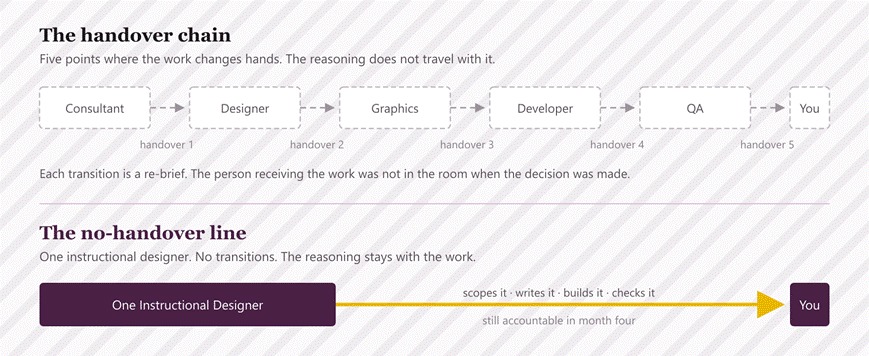
Ask any curriculum design firm one question: after kickoff, how many people touch this course before it reaches an LMS as a SCORM or xAPI package? In most of the category, the honest answer has four or five names in it.
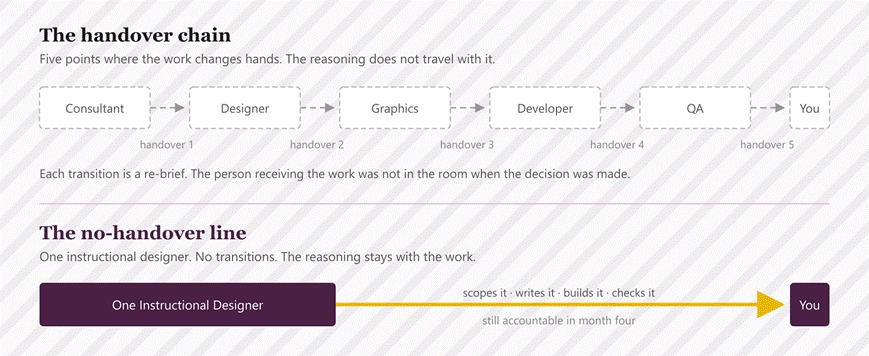
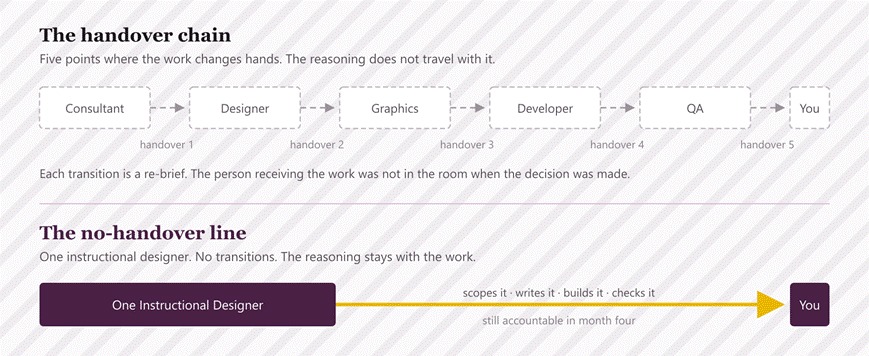
The handover chain versus the no-handover line. Reused verbatim from earlier posts.

The greyed chain above shows the conventional path. A consultant scopes the project, a designer storyboards it, graphics builds the visuals, a developer packages it in Articulate Storyline, and QA checks it before it reaches the buyer. Each arrow is a re-brief, and the person receiving the work was not in the room for the decision behind it.

The gold line below shows the alternative. One instructional designer scopes, writes and builds the course in the authoring tool, checks it personally, and hands it directly to the buyer. Whoever is accountable for quality is the same person who made every design decision.

An L&D Manager comparing two finalist proposals can ask this exact question on the first call, before any SOW is drafted.

>> See who would actually own your engagement before you sign anything

What This Doesn’t Include

An Instructional Design House is not the right fit for every curriculum project, and a firm worth shortlisting says so before you ask. VonGeyer’s September 2026 category research found none of five competitor sites stated a scope boundary.

Where this doesn’t apply

A single senior team cannot absorb a 10,000-seat enterprise rollout that needs five specialists working in parallel this month. Native mobile app development and live, in-room facilitation are outside scope too. Translation is priced and scoped separately, never bundled in.

That silence is the reason a boundary section belongs on a firm’s site before a call. It should not be something a buyer has to extract during one. A scope boundary stated in writing is also easier to hold a vendor to later, if the engagement drifts.

A Director of Programs comparing this against a large agency’s proposal should expect the same candor there. It rarely shows up unprompted.

What This Doesn’t Include, stated plainly

• Not a 10,000-seat enterprise rollout needing five specialists in parallel this month

• Not native mobile app development

• Not live, in-room facilitation

• Translation is priced and scoped separately, not bundled

What It Costs to Get This Wrong

Bringing an instructional designer in-house instead of hiring a firm is not automatically cheaper. That number rarely gets said out loud during a build-vs-buy conversation.
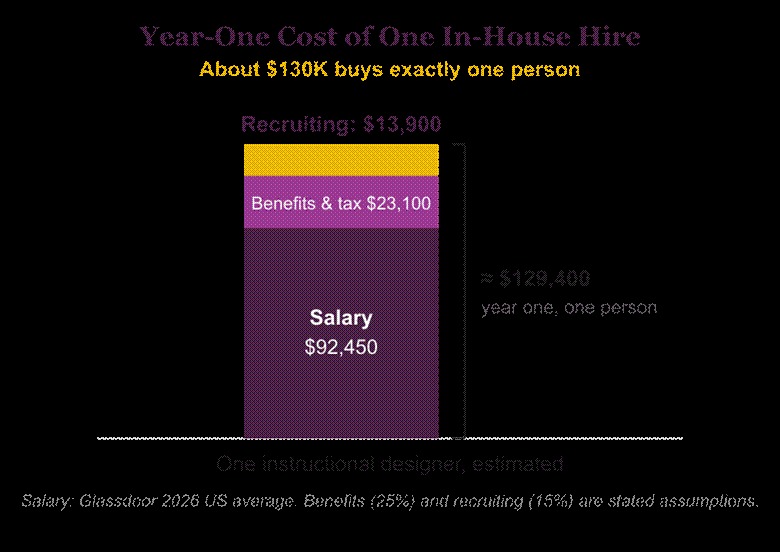
Estimated year-one cost of one in-house hire. Salary: Glassdoor 2026 US average. Benefits (25%) and recruiting (15%) are stated assumptions.

Glassdoor’s 2026 US data puts the average instructional designer salary at $92,450. Add benefits and payroll taxes at an assumed 25% and recruiting at 15% of salary, the low end of the common 15-25% range, and year one costs roughly $130,000. That buys exactly one person, after a search that rarely takes less than a couple of months, and the salary keeps running after the project ends.

A curriculum design firm’s cost per finished hour is comparable across proposals in a way a headcount request never is. That only works if the firm publishes a banded range instead of “contact us for pricing.” A vendor that will not name a range is asking a buyer to compare blind.

This is the number an L&D Manager needs on hand before finance asks why the vendor quote looks larger than a single salary line.

What Good Looks Like

The clearest proof a firm removed the handover, not just claimed to, is a project that shipped faster than the category norm without adding people. VonGeyer Consulting scripted, designed and built 20 hours of learning in 45 days, against a roughly 4-month industry baseline. The same senior designer who scoped the project was still accountable for it in month two.

A Director of Programs choosing between tiers should ask for this exact proof. Not a case study logo, but a timeline with a name attached to every stage of it. If a firm cannot produce one, the coordination layers it is quoting for are still there, whether or not the SOW admits it.

What Changes When You Get the Tier Right

A curriculum design firm sized to the actual project, not to the budget line it was drawn from, is the difference between a course that ships and a course that spends a quarter in revision. For a stretched L&D team running corporate curriculum development, that means capacity that closes the gap between what leadership asked for and what two open requisitions can deliver. It does not mean creating a second coordination job just to manage the vendor.

>> Tell Julian what you’re building and get a direct answer on fit

FAQ

How much does it cost to hire a curriculum design firm?

Most mid-sized firms price a defined project between $5,000 and $90,000, depending on complexity. Managed retainers for ongoing catalogue work run roughly $8,000 to $10,000 a month, and large production agencies typically start above that $90,000 band. Ask for cost per finished hour, not a day rate, to compare proposals fairly.

What’s the difference between a curriculum design firm and a single instructional designer?

A curriculum design firm has more than one person available, which matters once a project needs graphics, development and QA beyond one individual’s skill set. A single freelance instructional designer is often the right choice for one small, low-complexity course, but has no backup capacity if the project grows or they become unavailable.

Should a small L&D team use a freelancer or an agency?

Neither extreme usually fits a stretched enterprise team well. A freelancer suits a single small course, and a large agency adds coordination cost a small team does not need. A mid-sized Instructional Design House, sized for $5,000-$90,000 projects, is built for exactly this range.

How long does a typical curriculum design engagement take?

A single course built by a small senior team typically takes weeks to a few months, depending on complexity and how many SME review cycles it needs. VonGeyer Consulting has scripted, designed and built 20 hours of learning in 45 days against a roughly 4-month industry baseline. Large agency engagements usually run longer because of added review layers.

What questions should I ask before signing with a curriculum design firm?

Ask who builds the course after the person who scoped it hands it off, and whether that is the same person or a different team. Ask what the firm’s cost per finished hour is, and what drives it. Ask what the engagement explicitly does not include, and treat a vague answer as the answer.

Is a managed retainer cheaper than hiring an in-house instructional designer?

A fully loaded in-house hire runs roughly $130,000 in year one, on Glassdoor’s average salary plus assumed benefits and recruiting costs, and buys one person. A managed retainer in the $8,000-$10,000 a month range delivers a dedicated named designer without the recruiting cost or the start delay. It does not build the internal institutional capacity a hire eventually can.

White Label Course Development: How to Buy It Safely

White label course development means a company builds your training, but only your brand appears on it anywhere a learner or client can see. That is a different purchase than a white-label LMS. A platform is a delivery layer, and one 2026 industry analysis put it plainly: it “doesn’t solve the bigger cost problem most training providers face… content production.” The content still has to come from somewhere.

For a training company, consultancy or association, the appeal of buying that content externally is obvious. The risk most buyers ask about last is the one that matters most.

White label course development (definition)

White label course development is custom training built by an outside company and delivered without that company’s name, logo or watermark anywhere in the finished product. The buyer, not the developer, is the only name a learner or client ever sees. It is a production and branding arrangement, not a platform choice.

TL;DR

  1. White label course development puts your brand on training an outside team built, with no visible trace of who actually built it.
  2. It is a different purchase than a white-label LMS, which is a delivery platform, not a content source.
  3. The real risk is not quality. It is inheriting someone else’s handovers without ever being in the room to see them.
  4. Three engagement models exist: fully branded, co-branded, and fully white-label. Most buyers only ask about the third.
  5. Five questions belong in the contract before you resell anything built by someone else.
  6. Where VGC is not the right fit for this, stated plainly.

>> See what a full engagement actually looked like, from first call to final upload

What White Label Course Development Actually Means

A training company, consultancy or association gets a request it cannot build internally in time, or at all. Rather than turning it down or building an in-house team, it buys the content from a development partner and ships it under its own name.

The word “white label” is doing a specific job here: no outside logo, no visible vendor, nothing in the files, credits or metadata that tells a learner where the work actually came from. That is different from co-branding, where both names appear, and different again from a white-label LMS, which only controls how the course looks when delivered, not who wrote and built what is inside it.

The buyer is rarely a single L&D team. It is more often a training company selling a catalogue under its own name, an association producing certification-prep content for its members, or a consultancy that has sold a learning outcome without an in-house design bench to build it. In every case, the commercial relationship with the end client is the buyer’s to protect, not the developer’s, which is exactly why the next section matters more here than in a direct engagement.

Engagement Models, Compared

Not every arrangement needs to be fully white-label. The right one depends on what your own buyers expect to see.

ModelWhose Name ShipsBest For
Co-brandedBoth names, disclosedAssociations and training companies comfortable naming a delivery partner
Fully white-labelYour brand only, developer never appearsAgencies and training companies reselling capacity under their own name
VGC-branded (standard)VonGeyer ConsultingDirect enterprise buyers who want VGC named as the accountable partner

The Risk Unique to White Label Work

The assumption is that white labeling just means someone else’s logo comes off the finished file. The reality is that when your name is the only one attached, you inherit every handover inside your vendor’s process without ever being in the room to see it.

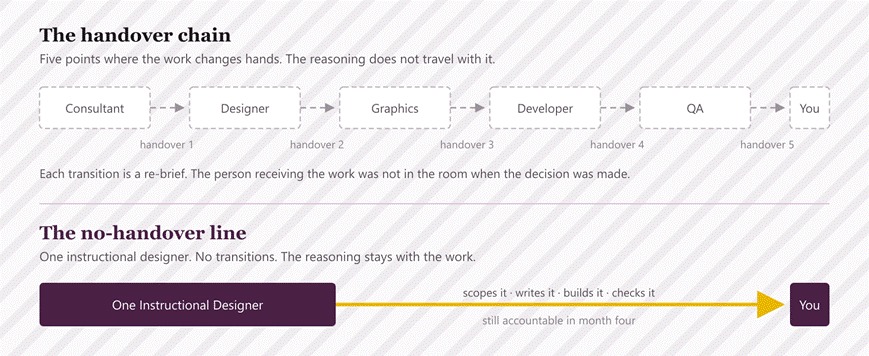
The handover chain versus the no-handover line. Reused verbatim a fifth time across posts.

In a direct engagement, a buyer who sees four different names touch their programme can ask questions at each handover. In a white-label arrangement, you only see the finished file. If the designer who scoped it is not the person who built it, and neither is still assigned by the time a client complains, you are the one fielding that complaint under your own name, several steps removed from anyone who can actually answer it.

That risk does not disappear because the branding is clean. It just becomes invisible until something goes wrong.

>> Meet the people who would own your engagement before you commit to anything

What to Put in the Agreement

Most of what protects a white-label buyer is written down before the first course ships, not negotiated after a problem appears.

TermWhat to Specify
BrandingNo developer name, logo, watermark or file metadata in any delivered asset
Source filesWho owns the editable project files once the engagement ends
ExclusivityWhether the developer can work with your direct competitors in the same niche
Team continuityWhether the same designer stays assigned across repeat engagements
Error correctionWho fixes a learner-facing error after launch, and the response time

Questions to Ask Any Learning Partner, White-Label Edition

The same rubric we would want asked of us, adapted for a buyer who is reselling the work, not just using it.

1. Will your name, watermark or file metadata appear anywhere in what we deliver to our own client?

2. Who owns the source files if we end the relationship?

3. Can the same designer stay assigned to us across repeat engagements, so quality stays consistent under our brand?

4. If a learner in our programme finds an error, who fixes it, and how fast?

5. Will you take on a competing training company or association in our same niche?

A firm that hesitates on the first question has not thought about white-label work as its own category. A firm that hesitates on the second is protecting lock-in.

Where this doesn’t apply

VonGeyer Consulting is a small senior team by design. We are the right fit for a training company or association that needs one accountable designer on a defined white-label programme, not a partner who can absorb your entire catalogue at volume from day one. If your need is a full-time embedded team across dozens of parallel titles, say so on the first call and we will tell you honestly whether we are the right size for it.

The Question Underneath the Purchase

The question is not whether the finished course looks clean under your brand. It is whether you know who actually built it, and whether that person is still reachable if something in it needs fixing after your client has already seen it.

>> Tell Julian what you’re building and get a direct answer on fit

FAQs

What is white label course development?

Custom training built by an outside company and delivered with no trace of that company’s name, logo or branding, so the buyer is the only name a learner or client ever sees.

How is white label course development different from a white-label LMS?

A white-label LMS is a branded delivery platform. It controls how a course looks when a learner opens it, not who wrote or built the content inside it. Buying platform whitelabeling does not solve content production.

Can we own the source files for white-label content?

That depends entirely on the contract. Ask explicitly for the editable project files, not only the finished, published package, or you cannot update the content later without going back to the original developer.

Will the developer’s branding appear anywhere in what we resell?

Only if the contract does not explicitly prohibit it. Specify no name, logo, watermark or file metadata in writing before the engagement starts, not after the first delivery.

What should be in a white-label course development contract?

Branding exclusions, source-file ownership, exclusivity within your niche, continuity of the assigned design team, and who is responsible for post-launch error correction.

Best Custom eLearning Development Companies (2026)

Custom eLearning development companies design and build training from scratch, rather than selling you a pre-made course off a catalogue. The right one depends on what you are building and what “good” needs to look like for your learners, not which name shows up first in search.

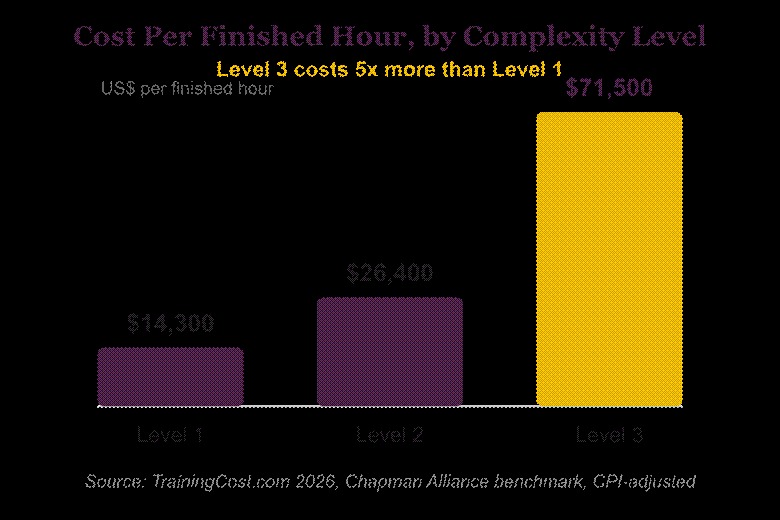
TrainingCost.com’s 2026 benchmark, based on the Chapman Alliance study, puts the cost of a finished hour of basic eLearning at roughly $14,300, rising to about $71,500 for simulation-level complexity. The company you pick changes that number as much as it changes the outcome.

This guide groups seven real companies by what each is genuinely strongest at, VonGeyer Consulting included, plus a checklist for reviewing any company’s portfolio before you shortlist them.

Short answer

There is no single best custom eLearning development company. The right choice depends on the complexity of what you are building, whether you need strategy and build from one accountable team or just production capacity, and how the company’s own portfolio holds up against the checklist below. This guide groups seven real options by what each is genuinely strongest at, not by an overall rank.

TL;DR

  1. Seven custom eLearning development companies, grouped by what each is genuinely strongest at, not ranked against each other.
  2. Cost per finished hour of eLearning runs from roughly $14,300 for simple content to $71,500 for simulation-level complexity.
  3. A portfolio review checklist for evaluating any company’s sample work before you shortlist them.
  4. VonGeyer Consulting is included for one specific strength: a single accountable team from strategy through build.
  5. Two of the seven companies here changed ownership in the last two years, worth knowing before you treat a case study as theirs.
  6. What VGC does not do, stated plainly, so you know when to look elsewhere.

>> See what a full engagement actually looked like, from first call to final upload

On this page

  • How We Grouped These Companies
  • The Companies at a Glance
  • The Full List
  • What Custom Development Actually Costs
  • The Portfolio Review Checklist
  • Why Who Actually Builds It Still Matters
  • What This Doesn’t Include
  • Frequently Asked Questions

How We Grouped These Companies

Ranking seven different companies against one scale hides more than it reveals: a company built for 10,000-seat enterprise rollouts and a company built for immersive VR modules are not competing for the same buyer. So instead of a single order, each company below is grouped by the one thing it is genuinely strongest at, drawn from its own published track record, case studies and public positioning.

VonGeyer Consulting is included for one specific strength: a single accountable team from strategy through build, not for being the biggest or the longest-running. Where that is not the fit, we say so in the boundary section near the end. The list runs alphabetically, not by preference.

The Companies at a Glance

Full assessments, including what to ask each company, follow this table.

CompanyWorth Asking About 
AllenCommPublished pricing transparencyWhether your build team is named or rotating
VonGeyer ConsultingOne accountable team, strategy through buildWhether you need capacity beyond a small senior team’s bandwidth
CommLab IndiaEnterprise scale, flexible engagement modelsWhether you get a named developer or a rotating team
ELM LearningA named, branded design methodologyIt self-ranks 4th of 10 in its own published comparison
Liberate GlobalGlobal enterprise scale and award historyConfirming which of three prior identities built your reference sample
SweetRushImmersive and VR-based custom contentHow the January 2026 NIIT acquisition changed who’s on your account
Upside LearningDocumented outcome case studiesHow the 2024 Mitr Learning & Media acquisition changed who’s on your account

The Full List

Each entry names the one thing the company is genuinely built for, and the one thing worth asking before you sign. Alphabetical order, not preference.

AllenComm

AllenComm publishes one of the category’s most detailed public cost guides, with a “cost per finished hour” framework and real pricing ranges, rare candor in a market where almost nobody quotes a number before a call. Worth asking: it positions as a large, broad-capability agency rather than a development specialist, so confirm who is actually named on your build team.

VonGeyer Consulting

VonGeyer Consulting is an Instructional Design House. That means the instructional designer who scopes your programme also writes it, builds it in the authoring tool and checks it. Every project is checked against design standards owned personally by Reena Roy, our Head of Design Strategy, who brings 25+ years of practice.

We build eLearning, video, instructor-led and virtual sessions, assessments and simulations. You can buy a defined project, or keep named designers month to month when your catalogue never stops needing updates.

  • A named Senior ID owns the engagement from first call to final upload.
  • You meet your designers before you commit.
  • AI helps with research, gap-filling and question banks. It does not write whole scripts, and your content never enters a language model.
  • Founded in 2021, we have designed and built 150+ hours of learning and delivered 9 programmes end to end.

Proof: a 90-hour real-estate licensure course rebuilt audio-first in five months, delivered into the client’s own LCMS. Our registered-supplier list includes Diageo, Suntory, Kennedys Law, Metro AG, Bajaj Finance and Aditya Birla Group. Worth asking: we are a small senior team by design, so a 10,000-seat rollout in three weeks needs a different kind of partner.

This list assumes you need external development capacity for a real programme, not just an opinion on your existing content. If you need instructional design strategy more than build capacity, our guide to the top instructional design companies for corporate training covers that lane.

CommLab India

CommLab India marked its 25th year in 2025, with 300+ clients and 110,000+ learning hours of custom content delivered across three engagement models, SOC 2 compliant. Worth asking: its own FAQ is written for 10,000+ employee enterprises, and it does not name individual delivery people publicly, so confirm who is building your specific programme.

ELM Learning

ELM Learning built Neurolearning™, a proprietary trademarked development methodology, as a genuine positioning asset. Worth asking: in its own published comparison of category leaders, ELM ranks itself 4th of 10, worth reading as both candor and as ELM’s own view of where it stands.

Liberate Global

Liberate Global carries real enterprise scale: 10 million-plus learners, 600-plus awards, and testimonials from Boeing, World Bank and Regeneron. The entity has changed names and ownership twice in under four years: EI Design became “EI” under MPS Interactive in 2022, then unified with MPS Europa and Liberate Learning into Liberate Global in April 2026. Worth asking: which of those three prior identities actually built the reference sample you were shown.

SweetRush

SweetRush has a 25-year track record, was named Training Industry’s Top Custom Content Development Company for a 12th straight year in 2026, and is a recognized leader in immersive and VR learning, with named clients including Bank of America and Hilton. NIIT Learning Systems acquired SweetRush in January 2026 for up to $26 million. Worth asking: it is no longer independent, and pricing runs at the premium end with no published rate card.

Upside Learning

Upside Learning has 20 years in the category and a case study reporting 58% faster course completion across 1,700 workers, with named client testimonials carrying real photos. Mitr Learning & Media acquired Upside Learning in 2024. Worth asking: its site names no instructional designers, so ask directly who is building and reviewing your programme, and how the acquisition changed that answer.

What Custom Development Actually Costs

The company you choose changes the number as much as it changes the outcome. TrainingCost.com’s 2026 analysis, applying CPI inflation to the Chapman Alliance benchmark, puts a finished hour of basic, page-turner content at around $14,300.

Cost per finished hour by complexity level. Source: TrainingCost.com 2026, Chapman Alliance benchmark.

That rises to roughly $26,400 for interactive or branching content, and up to $71,500 for simulation-level complexity, a five-times spread between the simplest and most demanding tier.

That gap is usually bigger than the difference between any two companies’ day rates, which is why scoping the complexity level honestly matters more than picking a name off this list.

>> Meet the people who would own your engagement before you commit to anything

The Portfolio Review Checklist

Every company on this list will send you sample work. Most samples look impressive on a call. Fewer survive this checklist.

The Portfolio Review Checklist

• Does the sample match your content type? A polished sales-enablement demo tells you nothing about compliance-training instincts.

• Is there a real learner outcome attached, or just a description of what was built?

• Can they name who on the sample project still works there today?

• Does the sample show a design decision, a tradeoff made or a constraint solved, or just a finished screen?

• Is the sample recent, within the last 18 months, or years old?

• Would it survive being shown on a phone, not just a widescreen demo reel?

A company that answers all six honestly is rarer than a company with an impressive-looking portfolio. The two are not the same thing.

Why Who Actually Builds It Still Matters

The assumption is that a strong portfolio means a strong process. The reality is that a portfolio shows you the output, not who was in the room when the decisions were made.

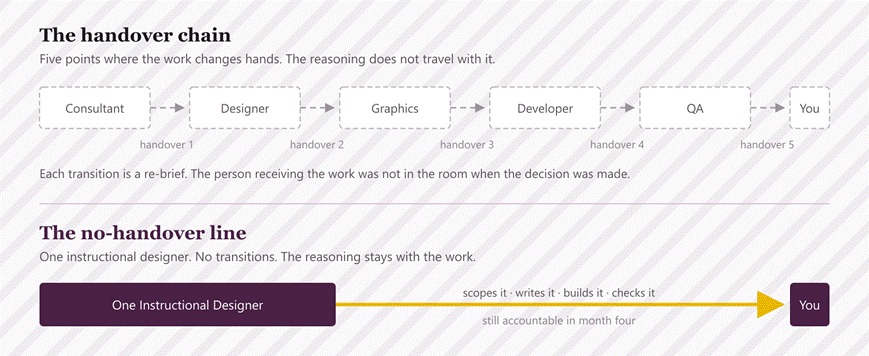
The handover chain versus the no-handover line. Reused verbatim across all four posts.

Inside a conventional production vendor, a designer scopes the work, then hands it to graphics, then a developer, then QA. The portfolio sample you were shown may have passed through all four hands, and the person who made the instructional judgment call may no longer work there, or may not be assigned to your account at all.

That is not dishonesty. It is how most of this category is built and staffed. The question worth asking any company on this list, including us, is how many names it takes to get from your brief to your finished programme, and whether the person behind the sample you liked is the person you will actually get.

What This Doesn’t Include

VonGeyer Consulting does not do everything on this list, and says so before it costs you a wasted call.

Where this doesn’t apply

We are not an LMS vendor and do not administer or configure platforms. We do not run live facilitation, and we do not build native mobile applications. We are a small senior team by design, so a 10,000-seat enterprise rollout in three weeks needs a partner with broader bench capacity than ours. Translation is priced separately, never bundled to make a quote look smaller.

The Question Underneath the List

The question is not which name on this list has the most polished portfolio. It is whether the person behind the sample you liked is the person who will actually build your programme, and whether they are still there to be accountable for it.

Two of the seven companies here already changed ownership once. Review any company’s portfolio against the checklist above before you sign anything.

>> Tell Julian what you’re building and get a direct answer on fit

FAQs

What is the best custom eLearning development company?

There is no single best company. The right choice depends on the complexity of what you are building, whether you need strategy and build from one team or just production capacity, and how the company’s portfolio holds up against a real checklist.

How much does custom eLearning development cost?

Cost per finished hour runs from roughly $14,300 for basic, page-turner content to about $26,400 for interactive or branching content, and up to $71,500 for simulation-level complexity, based on 2026 CPI-adjusted Chapman Alliance benchmarks.

What is the difference between custom eLearning and off-the-shelf courses?

Off-the-shelf courses are pre-built and licensed as-is. Custom development designs and builds training specific to your content, audience and systems, which costs more but fits your actual programme rather than a generic one.

How do I review an eLearning development company’s portfolio?

Check whether the sample matches your content type, whether a real outcome is attached, whether the people who built it still work there, and whether it shows a design decision rather than just a finished screen. The checklist above covers all six questions.

Should I hire an agency or a freelancer for custom eLearning development?

An agency suits programmes needing multiple disciplines, like assessment design, media production and accessibility, coordinated together. A freelancer can suit a single, well-scoped module where one person can reasonably do it all.

What questions should I ask before hiring an eLearning development company?

Who specifically will build it, who checks it, what happens when scope changes, and whether the portfolio sample they showed you was built by someone still on their team.

Top Instructional Design Companies for Corporate Training (2026)

Instructional design companies range from solo freelancers to 800-person agencies, and the right one depends on what you actually need built, not which name is most familiar. This list ranks eight companies buyers in this category consider, VonGeyer Consulting included, against the same questions we would want asked of us.

The category is growing fast enough that the choice matters. Grand View Research puts the global e-learning services market at $352.98 billion in 2025, projected to reach $1,485.0 billion by 2033.

That growth is also pulling the category through consolidation, which changes what “established” actually means when you are evaluating a company today.

Short answer

There is no single best instructional design company. The right choice depends on whether you need a diagnosis, a one-off build, ongoing managed capacity, or a specific skill like immersive production, and on how many names it takes that company to answer who actually designs, builds and checks your programme. This list ranks eight real options against that question, not just against size.

TL;DR

Eight instructional design companies compared, ranked by track record, delivery transparency, and how directly each answers who actually does the work.

The global e-learning services market is projected to more than quadruple by 2033, and the category is consolidating fast.

Two of the eight companies on this list changed ownership since 2024. Worth asking any “established” firm whether that is true of them too.

VonGeyer Consulting ranks #2, on the strength of one named senior designer answering all five questions in our No-Handover Check.

The five questions in the No-Handover Check work on any firm on this list, including us.

Staff augmentation, consulting, and full-cycle instructional design are three different purchases. This list spans all three.

>> See what a full engagement actually looked like, from first call to final upload

On this page

●        How We Selected These Companies

●        The List at a Glance

●        The Full List

●        Why This Category Is Consolidating Fast

●        Why Who Actually Builds It Matters More Than the Logo

●        The No-Handover Check

●        Frequently Asked Questions

How We Selected These Companies

We looked at four things for each company: how long they have operated at this specific work, how transparent they are about who actually designs, builds and checks a programme, how clearly they state what a programme costs, and what kind of buyer they are genuinely built for. No company is strong on all four, including us.

VonGeyer Consulting is included alongside seven more established names because of one specific answer: a single named senior designer can answer all five questions in the No-Handover Check below, start to finish. Where we are not the right fit, our own entry below says so directly. The list is presented alphabetically, not by preference.

The List at a Glance

Full assessments, including what to ask each company, follow this table.

CompanyWorth Asking About 
AllenCommBuyers who want published pricing logic before the first callWhether your account gets a named specialist or a rotating generalist team
VonGeyer ConsultingTeams that need one accountable senior designer, start to finishWhether you need capacity beyond a small senior team’s bandwidth
CommLab IndiaBroad enterprise programmes needing proven scaleWhether you get a named designer or a rotating team
ELM LearningMid-market buyers drawn to a named methodologyIt self-ranks 4th of 10 in its own published comparison
IngenuitiA fast, single specialist hire, not a full programmeStaff augmentation puts a contractor under your management, not a partner accountable for the outcome
Liberate GlobalEnterprise buyers who want scale and award historyConfirming which of three prior company identities actually built your reference case studies
SweetRushImmersive/VR and high-production custom contentHow the January 2026 NIIT acquisition changed who’s on your account
Upside LearningBuyers who want a documented outcome case study firstHow the 2024 Mitr Learning & Media acquisition changed who’s on your account

The Full List

Each entry states what the company is genuinely good at, and the one thing worth asking before you sign. Alphabetical order, not preference order.

AllenComm

AllenComm publishes one of the category’s most detailed public cost guides, with a “cost per finished hour” framework and real pricing ranges, rare candor in a category where almost nobody quotes a number in public. Worth asking: it positions as a large, broad-capability agency rather than a specialist, so ask specifically who is named on your account, not just what the agency has built before.

VonGeyer Consulting

VonGeyer Consulting is an Instructional Design House: the same senior designer who scopes your programme also builds it and is checked against standards our Head of Design Strategy owns personally. Proof: a 90-hour real-estate licensure course rebuilt audio-first in five months, delivered into the client’s own LCMS, for a registered-supplier list that includes Diageo, Suntory, Kennedys Law, Metro AG, Bajaj Finance and Aditya Birla Group. Worth asking: we are a small senior team by design, so a 10,000-seat rollout in three weeks needs a different kind of partner.

This list assumes you need external instructional design capacity for a real programme.

CommLab India

CommLab India marked its 25th year in 2025, with 300+ clients and 110,000+ learning hours delivered across three engagement models, SOC 2 compliant. It ranked #2 on eLearning Industry’s 2026 Top eLearning Staff Augmentation Services list. Worth asking: its own FAQ is written for 10,000+ employee enterprises, and it does not name individual delivery people publicly, so ask directly who is assigned to your programme.

ELM Learning

ELM Learning built Neurolearning™, a proprietary trademarked methodology, as a genuine positioning asset. Worth asking: in its own published comparison of category leaders, ELM ranks itself 4th of 10, worth reading both as candor and as ELM’s own view of where it stands relative to the rest of this list.

Ingenuiti

Ingenuiti has a 30-year legacy in instructional design staff augmentation and promises a candidate resume within 24 to 48 hours, genuinely fast when the gap is a person, not a programme. Worth asking: staff augmentation places a contractor under your management and your accountability, not a partner who owns the outcome. That speed is also the tradeoff.

Liberate Global

Liberate Global carries real enterprise scale: 10 million-plus learners, 600-plus awards, and testimonials from Boeing, World Bank and Regeneron. The entity has changed names and ownership twice in under four years: EI Design became “EI” under MPS Interactive in 2022, then unified with MPS Europa and Liberate Learning into Liberate Global in April 2026. Worth asking: which of those three prior identities actually built the case study you were shown, and whether the same people are still there.

SweetRush

SweetRush has a 25-year track record, was named Training Industry’s Top Custom Content Development Company for a 12th straight year in 2026, and is a recognized leader in immersive and VR learning, with named clients including Bank of America and Hilton. NIIT Learning Systems acquired SweetRush in January 2026 for up to $26 million. Worth asking: it is no longer independent, pricing runs at the premium end with no published rate card, and it’s worth confirming who on your account predates the acquisition.

Upside Learning

Upside Learning has 20 years in the category and a case study reporting 58% faster course completion across 1,700 workers, with named client testimonials carrying real photos. Mitr Learning & Media acquired Upside Learning in 2024. Worth asking: its own buyer guide argues that “instructional judgment is rare,” yet its site names no instructional designers, so ask who is judging your programme, and how the acquisition changed that answer.

Where this doesn’t apply

If you already have a strong in-house design team and just need a specific gap filled, like an LMS migration or a translation vendor, none of these eight companies is the right spend. Look for that specialist instead. And if you have not yet defined what the programme needs to change, an instructional design company is not your first call; an L&D consultant is.

Why This Category Is Consolidating Fast

2 of 8 companies on this list changed ownership since 2024

Upside Learning (acquired by Mitr Learning & Media, 2024) and SweetRush (acquired by NIIT Learning Systems, January 2026) are both on this list and both no longer independent. That is not a coincidence.

Source: Upside Learning press release; PR Newswire, NIIT/SweetRush

Global e-learning services market, 2025 to 2033 projected. Source: Grand View Research.

Grand View Research puts the global e-learning services market at $352.98 billion in 2025, projected to reach $1,485.0 billion by 2033. Growth at that pace draws acquirers, and acquisitions change who is actually accountable for your programme, whether or not the name on the door changes with it.

>> See who would actually own your engagement before you sign anything

Why Who Actually Builds It Matters More Than the Logo

The assumption is that a bigger, more established name means more stability. The reality is that scale does not remove the handover, it just moves it further from view.

The handover chain versus the no-handover line. Reused verbatim from posts 1 and 2.

Inside a conventional production vendor, whether it has 20 people or 800, a designer scopes the work, then hands it to graphics, then a developer, then QA. Acquisitions add a layer on top: the team that built the case study you were shown may not be the team assigned to your programme once ownership changes.

None of the eight companies on this list are dishonest about this. It is how the category is built. The question worth asking any of them, including us, is how many names it takes to get from your brief to your finished programme.

The No-Handover Check

This is the five-line test behind why we are comfortable being on this list at all. Ask it of any company here, including us.

The No-Handover Check

• Who designed it? Name and years of experience.

• Who built it in the authoring tool? Same person, or a different one?

• Who checked it, and against whose written standard?

• What exactly did AI do, and what did it not do?

• Who owned the engagement from first call to final upload?

On our own 90-hour licensure rebuild, one senior designer answers the first two lines, and our Head of Design Strategy answers the third against standards she owns personally. A company that has changed hands recently may need a moment to answer the fifth.

The Question Underneath the List

The question is not which name on this list is most familiar. It is how many people it takes to get from your brief to a finished programme, and whether the same people will still be there in month four.

Two of the eight companies here already changed hands once. Ask any company on this list, including us, the five questions in the No-Handover Check before you sign anything.

>> Tell Julian what you’re building and get a direct answer on fit

FAQs

What is the best instructional design company for corporate training?

There is no single best company. The right choice depends on whether you need a diagnosis, a one-off build, ongoing managed capacity, or a specialist skill like immersive production, and on how directly the company can answer who actually designs, builds and checks your programme.

How much do instructional design companies charge?

Pricing is rarely published. Custom development is typically priced per finished hour of learning, with US agency rates commonly between $100 and $150 an hour, varying with interactivity, media complexity, and accessibility standard.

What is the difference between an instructional design company and an eLearning development company?

In practice the terms overlap. Instructional design covers the analysis and structure of what people need to learn; eLearning development covers building it in an authoring tool. Most companies on this list, including VonGeyer, do both.

Should I hire an instructional design agency or build an in-house team?

Build in-house when the need is permanent and steady. Hire a company when the work is bounded, the deadline is fixed, or the capability gap is genuine and time-limited.

What should I ask any instructional design company before hiring them?

The five questions in the No-Handover Check above: who designs it, who builds it, who checks it, what AI does, and who owns the engagement start to finish.

Are staff augmentation and instructional design outsourcing the same thing?

No. Staff augmentation places an individual contractor under your management, so you carry the accountability. Outsourcing hands a defined scope to a company that owns delivery and remains accountable for the outcome.

What L&D Consulting Firms Actually Do (And When You Need One)

L&D consulting firms diagnose why a learning problem exists and recommend what to do about it. Most stop at the recommendation. Building what it describes then becomes a separate purchase, from a separate supplier.

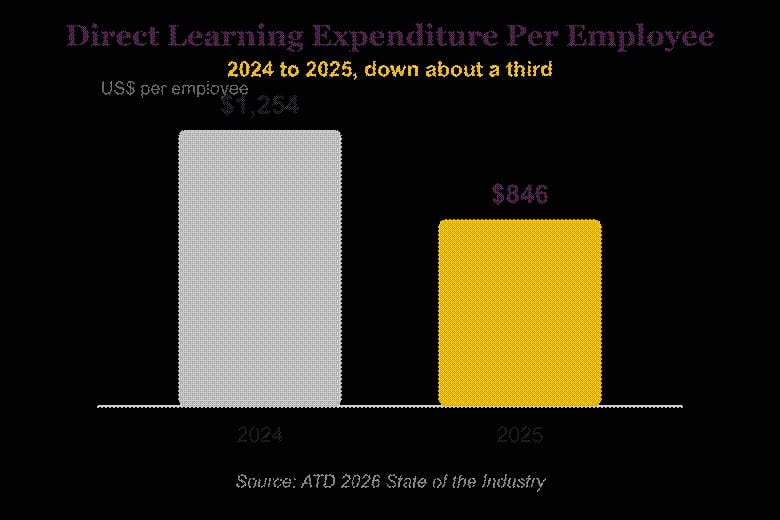
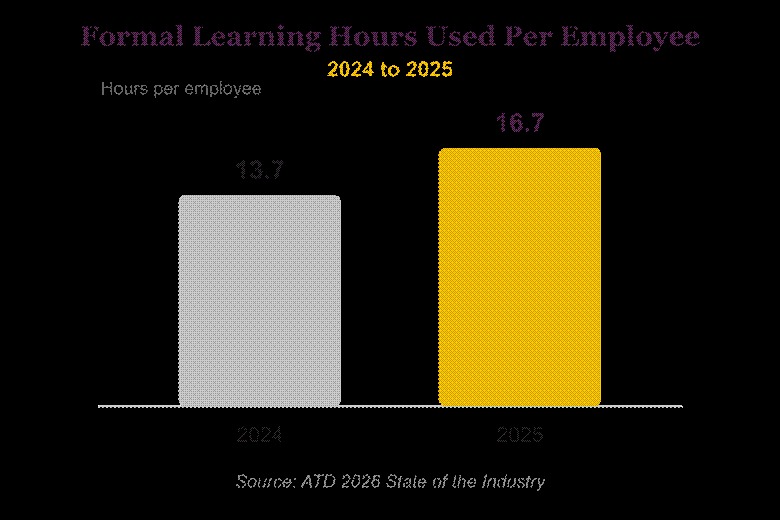
If you are the Head of Learning inside a 5,000-person business, that gap is where budget and momentum go missing. ATD’s 2026 State of the Industry found direct learning expenditure fell to $846 per employee in 2025, down from $1,254 the year before, while formal learning hours used per employee rose to 16.7 from 13.7.

That is the squeeze a Head of Learning is looking for outside help inside right now, and it changes what the right help looks like. What follows: what these firms deliver, what an engagement costs, and when not to hire one at all.

L&D consulting (definition)

L&D consulting is the paid diagnosis of a learning problem and the design of a response to it: a needs analysis, a skills gap map, a curriculum structure, a delivery approach. It is a decision-making purchase, not a production purchase, and in most firms the people who write the plan are not the people who build what it specifies.

TL;DR

  1. L&D consulting buys you a diagnosis and a plan, not finished learning.
  2. The single most expensive moment is the handover from the firm that wrote the strategy to whoever builds it.
  3. Direct learning spend per employee fell about a third in 2025 while hours delivered rose.
  4. Consulting and building are separate purchases in most of the market. They do not have to be.
  5. Count the handovers on your last project and multiply by your review-cycle length for your real coordination cost.
  6. The five questions in the No-Handover Check separate a design partner from a chain of suppliers.
  7. Skip the consultant entirely when you already know what to build and only lack the capacity to build it.

>> See what a full engagement actually looked like, from first call to final upload

What an L&D Consulting Engagement Actually Delivers

An L&D consultant investigates a performance problem and tells you what learning, if any, will fix it. Standard deliverables: a needs analysis, a skills gap map, a curriculum structure, a measurement plan, a build roadmap. What almost none include is the finished learning itself.

That distinction sounds obvious on paper. In a proposal, “learning strategy and design” can mean a document or a delivered course, and the two differ by an order of magnitude in cost.

The demand for the diagnosis half is real and driven from above. LinkedIn’s 2025 Workplace Learning Report found 49% of L&D professionals agree their executives doubt employees have the skills to execute business strategy. That concern usually reaches a Head of Learning as a question, not a budget. A consultant is the fastest route to a defensible answer, and the problem is what happens to it next.

The Seam Nobody Prices: Where a Strategy Becomes a Build

The assumption is that consulting and building are naturally separate purchases. The reality is that the join between them is where most learning strategy quietly dies.

A consulting engagement ends with a document. Somebody turns it into a storyboard, then a build in Articulate Storyline or Rise, then a SCORM or xAPI package that survives contact with your LMS. In the conventional model each stage belongs to a different team, and every transition is a re-brief.

The handover chain versus the no-handover line.

The chain has five points where work changes hands, and the reasoning does not travel with it. The line below has none. That is the entire structural difference between two firms quoting similar numbers.

An Instructional Design House removes that seam rather than managing it: a firm where the designers who scope the work also write, build and check it. Not a claim about effort. A claim about how many times a decision gets re-explained.

Consultant, Build Partner, or Both

Three purchases exist in this market, and buyers routinely make the wrong one. The table separates them by what you actually have on day one.

If your situation isWhat you should buyWhat it looks like when you buy wrong
You know something is failing but not why, and cannot describe the programme yetConsulting. A diagnosis and a planYou commission a build against a guess, then pay to rebuild it after the first pilot
You know exactly what to build and to what standard, and only lack handsA build partner. Design and development capacityYou pay consulting rates to be told what you already knew, and lose a quarter doing it
You know the outcome you need but not the curriculum, with a date attachedBoth, bought from one accountable partyThe strategy arrives, the build is quoted separately, and the plan expires before it is funded
Your catalogue keeps growing and the need is permanent, not a projectOngoing managed design capacityYou re-run procurement three times a year and lose the context each time

The third row is the common, expensive one: a plan with no funded route to production is a well-researched opinion with a shelf life, not a strategy. The fourth is where certification bodies and licensing schools land, usually after two project cycles, once learning itself becomes the permanent product.

The Budget Squeeze, in Two Numbers

Two figures from the same ATD report frame the conversation right now.

Direct learning expenditure per employee, 2024 to 2025. Source: ATD 2026 State of the Industry.

Direct learning expenditure per employee fell to $846 in 2025, down from $1,254 the year before, a decline of roughly a third.

Formal learning hours used per employee, 2024 to 2025. Source: ATD 2026 State of the Industry.

Formal learning hours used per employee moved the other way, rising to 16.7 from 13.7. Teams are being asked to deliver more learning on materially less money, and that arithmetic is what makes an unbuilt strategy expensive rather than merely disappointing.

Count the Handovers: A Calculation for Your Last Project

Here is an exercise no vendor will run for you, using a project you already paid for. It takes about ten minutes and is more revealing than any capability deck.

1. List every party who touched the work, and count them.

2. Count the transitions, not the people. Five parties means four handovers.

3. Find your actual review turnaround, not the contracted figure, typically four to eight working days per round.

4. Multiply handovers by turnaround. Four handovers at five days is twenty working days spent re-briefing.

5. Count the rework caused by lost intent. Feedback that is “technically right but misses the point” is a handover cost, not a quality one.

Steps four and five together are usually the gap between the quoted timeline and the real one.

From the desk

The tell is not delay, it is the flavour of the feedback. Once a review round produces “this is accurate but not what we meant” twice, adding more reviewers makes it worse, because you are adding interpreters, not removing them.

>> Meet the people who would own your engagement before you commit to anything

The No-Handover Check

This is a five-line test you can apply to any firm, including ours. Ask it about a specific piece of delivered work, not a process description. A firm running a conventional handover model will answer with four or five different names, truthfully.

The No-Handover Check

• Who designed it? Name and years of experience.

• Who built it in the authoring tool? Same person, or a different one?

• Who checked it, and against whose written standard?

• What exactly did AI do, and what did it not do?

• Who owned the engagement from first call to final upload?

Run it on our 90-hour real estate licensure rebuild. One senior instructional designer answers the first two lines; Reena Roy, our Head of Design Strategy, answers the third, against standards she owns personally. The fifth line is that same named designer, first call to final upload. On the fourth: AI did research, gap-filling and question-bank drafting. It did not write scripts, and no client content went into a language model.

How to Evaluate a Firm Before You Shortlist It

Most of this decision happens before anyone speaks to a salesperson. 6sense’s 2025 B2B Buyer Experience Report found buyers purchase from one of the four vendors on their day-one shortlist 95% of the time, and a further 83% define their requirements before speaking with sales at all. For a Director of Programs, the useful evaluation work happens before the calls, not during them.

Two of the twelve buyer scorecard criteria matter most here. Instructional judgment: ask for one decision the firm made against the client’s stated preference, and why. On the licensure rebuild, the client expected more video; we recommended audio-first instead, because their learners studied in cars. Measurable outcomes: ask what was measured, who measured it, and what the number was before. A firm that treats measurement as a deliverable has baselines; a firm that treats it as marketing has adjectives.

When You Do Not Need an L&D Consultant

Four situations where hiring one costs you time you do not have. We would rather say this on a first call than three months in.

You already know what to build. If you can describe the programme, audience, standard and deadline, you have done the consulting.

The problem is not a learning problem. Broken process or unclear accountability will not be fixed by a course.

Nobody internally can act on the recommendation. A strategy needs an owner with authority to fund it.

The need is permanent, not a project. Recurring catalogue work at a steady volume is a capacity question, not a strategy one.

Where this doesn’t apply

We are not an LMS vendor and do not administer or configure platforms. We do not run live facilitation, and we do not build native mobile applications. Translation is priced separately. If your problem is platform selection or systems integration, a firm like ours is the wrong spend.

The Decision Underneath the Decision

The question is rarely which L&D consulting firm to hire. It is whether you are buying a diagnosis, a delivery capability, or one accountable party who covers both.

Budgets are tighter than eighteen months ago. A plan you cannot afford to build is now a real cost, not a harmless document. Get the build estimate alongside the strategy, and count the handovers before you sign anything.

You want capacity that does not create more management work than it absorbs, and a named senior designer who owns the work from first call to final upload.

>> Talk to us about what your programme would actually take

FAQs

What does an L&D consultant do?

Diagnoses why a workforce performance problem exists and recommends what learning, if any, will address it. Typical deliverables are a needs analysis, a skills gap map and a measurement plan.

What is a typical L&D budget?

No single figure applies, but the common benchmark is direct learning expenditure per employee: $846 in 2025, down from $1,254 the year before, per ATD.

What is the difference between L&D consulting and instructional design?

Consulting decides what should be built and why. Instructional design decides how it gets built so people actually learn it, and in many firms also builds it.

Do I need a consultant or a build partner?

Buy consulting when you cannot yet describe the programme, audience or standard with confidence. Buy a build partner when you can describe all three and only lack the people.

How long does an L&D consulting engagement take?

A focused diagnostic on one programme typically runs a few weeks. A full portfolio review runs longer, since the constraint is stakeholder availability, not analysis time.

Should the strategy firm also build the courses?

Not always, but know what you give up. Splitting the two adds a handover exactly where design reasoning matters most.