
White label course development means a company builds your training, but only your brand appears on it anywhere a learner or client can see. That is a different purchase than a white-label LMS. A platform is a delivery layer, and one 2026 industry analysis put it plainly: it “doesn’t solve the bigger cost problem most training providers face… content production.” The content still has to come from somewhere.
For a training company, consultancy or association, the appeal of buying that content externally is obvious. The risk most buyers ask about last is the one that matters most.
White label course development (definition)
White label course development is custom training built by an outside company and delivered without that company’s name, logo or watermark anywhere in the finished product. The buyer, not the developer, is the only name a learner or client ever sees. It is a production and branding arrangement, not a platform choice.
TL;DR
- White label course development puts your brand on training an outside team built, with no visible trace of who actually built it.
- It is a different purchase than a white-label LMS, which is a delivery platform, not a content source.
- The real risk is not quality. It is inheriting someone else’s handovers without ever being in the room to see them.
- Three engagement models exist: fully branded, co-branded, and fully white-label. Most buyers only ask about the third.
- Five questions belong in the contract before you resell anything built by someone else.
- Where VGC is not the right fit for this, stated plainly.
>> See what a full engagement actually looked like, from first call to final upload
What White Label Course Development Actually Means
A training company, consultancy or association gets a request it cannot build internally in time, or at all. Rather than turning it down or building an in-house team, it buys the content from a development partner and ships it under its own name.
The word “white label” is doing a specific job here: no outside logo, no visible vendor, nothing in the files, credits or metadata that tells a learner where the work actually came from. That is different from co-branding, where both names appear, and different again from a white-label LMS, which only controls how the course looks when delivered, not who wrote and built what is inside it.
The buyer is rarely a single L&D team. It is more often a training company selling a catalogue under its own name, an association producing certification-prep content for its members, or a consultancy that has sold a learning outcome without an in-house design bench to build it. In every case, the commercial relationship with the end client is the buyer’s to protect, not the developer’s, which is exactly why the next section matters more here than in a direct engagement.
Engagement Models, Compared
Not every arrangement needs to be fully white-label. The right one depends on what your own buyers expect to see.
| Model | Whose Name Ships | Best For |
| Co-branded | Both names, disclosed | Associations and training companies comfortable naming a delivery partner |
| Fully white-label | Your brand only, developer never appears | Agencies and training companies reselling capacity under their own name |
| VGC-branded (standard) | VonGeyer Consulting | Direct enterprise buyers who want VGC named as the accountable partner |
The Risk Unique to White Label Work
The assumption is that white labeling just means someone else’s logo comes off the finished file. The reality is that when your name is the only one attached, you inherit every handover inside your vendor’s process without ever being in the room to see it.
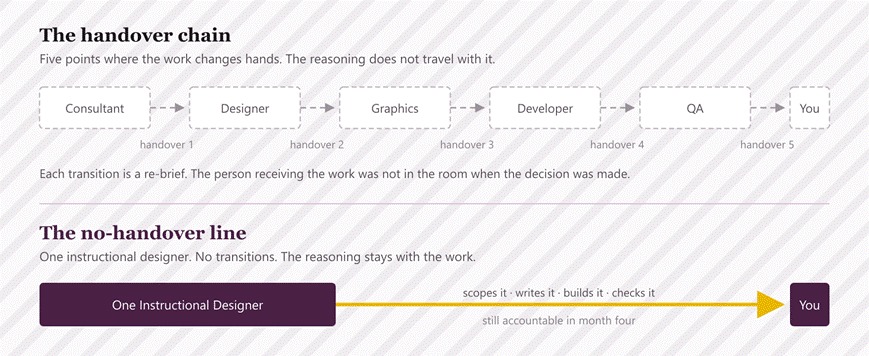
The handover chain versus the no-handover line. Reused verbatim a fifth time across posts.
In a direct engagement, a buyer who sees four different names touch their programme can ask questions at each handover. In a white-label arrangement, you only see the finished file. If the designer who scoped it is not the person who built it, and neither is still assigned by the time a client complains, you are the one fielding that complaint under your own name, several steps removed from anyone who can actually answer it.
That risk does not disappear because the branding is clean. It just becomes invisible until something goes wrong.
>> Meet the people who would own your engagement before you commit to anything
What to Put in the Agreement
Most of what protects a white-label buyer is written down before the first course ships, not negotiated after a problem appears.
| Term | What to Specify |
| Branding | No developer name, logo, watermark or file metadata in any delivered asset |
| Source files | Who owns the editable project files once the engagement ends |
| Exclusivity | Whether the developer can work with your direct competitors in the same niche |
| Team continuity | Whether the same designer stays assigned across repeat engagements |
| Error correction | Who fixes a learner-facing error after launch, and the response time |
Questions to Ask Any Learning Partner, White-Label Edition
The same rubric we would want asked of us, adapted for a buyer who is reselling the work, not just using it.
1. Will your name, watermark or file metadata appear anywhere in what we deliver to our own client?
2. Who owns the source files if we end the relationship?
3. Can the same designer stay assigned to us across repeat engagements, so quality stays consistent under our brand?
4. If a learner in our programme finds an error, who fixes it, and how fast?
5. Will you take on a competing training company or association in our same niche?
A firm that hesitates on the first question has not thought about white-label work as its own category. A firm that hesitates on the second is protecting lock-in.
Where this doesn’t apply
VonGeyer Consulting is a small senior team by design. We are the right fit for a training company or association that needs one accountable designer on a defined white-label programme, not a partner who can absorb your entire catalogue at volume from day one. If your need is a full-time embedded team across dozens of parallel titles, say so on the first call and we will tell you honestly whether we are the right size for it.
The Question Underneath the Purchase
The question is not whether the finished course looks clean under your brand. It is whether you know who actually built it, and whether that person is still reachable if something in it needs fixing after your client has already seen it.
>> Tell Julian what you’re building and get a direct answer on fit
FAQs
What is white label course development?
Custom training built by an outside company and delivered with no trace of that company’s name, logo or branding, so the buyer is the only name a learner or client ever sees.
How is white label course development different from a white-label LMS?
A white-label LMS is a branded delivery platform. It controls how a course looks when a learner opens it, not who wrote or built the content inside it. Buying platform whitelabeling does not solve content production.
Can we own the source files for white-label content?
That depends entirely on the contract. Ask explicitly for the editable project files, not only the finished, published package, or you cannot update the content later without going back to the original developer.
Will the developer’s branding appear anywhere in what we resell?
Only if the contract does not explicitly prohibit it. Specify no name, logo, watermark or file metadata in writing before the engagement starts, not after the first delivery.
What should be in a white-label course development contract?
Branding exclusions, source-file ownership, exclusivity within your niche, continuity of the assigned design team, and who is responsible for post-launch error correction.
