
Custom eLearning development companies design and build training from scratch, rather than selling you a pre-made course off a catalogue. The right one depends on what you are building and what “good” needs to look like for your learners, not which name shows up first in search.
TrainingCost.com’s 2026 benchmark, based on the Chapman Alliance study, puts the cost of a finished hour of basic eLearning at roughly $14,300, rising to about $71,500 for simulation-level complexity. The company you pick changes that number as much as it changes the outcome.
This guide groups seven real companies by what each is genuinely strongest at, VonGeyer Consulting included, plus a checklist for reviewing any company’s portfolio before you shortlist them.
Short answer
There is no single best custom eLearning development company. The right choice depends on the complexity of what you are building, whether you need strategy and build from one accountable team or just production capacity, and how the company’s own portfolio holds up against the checklist below. This guide groups seven real options by what each is genuinely strongest at, not by an overall rank.
TL;DR
- Seven custom eLearning development companies, grouped by what each is genuinely strongest at, not ranked against each other.
- Cost per finished hour of eLearning runs from roughly $14,300 for simple content to $71,500 for simulation-level complexity.
- A portfolio review checklist for evaluating any company’s sample work before you shortlist them.
- VonGeyer Consulting is included for one specific strength: a single accountable team from strategy through build.
- Two of the seven companies here changed ownership in the last two years, worth knowing before you treat a case study as theirs.
- What VGC does not do, stated plainly, so you know when to look elsewhere.
>> See what a full engagement actually looked like, from first call to final upload
On this page
- How We Grouped These Companies
- The Companies at a Glance
- The Full List
- What Custom Development Actually Costs
- The Portfolio Review Checklist
- Why Who Actually Builds It Still Matters
- What This Doesn’t Include
- Frequently Asked Questions
How We Grouped These Companies
Ranking seven different companies against one scale hides more than it reveals: a company built for 10,000-seat enterprise rollouts and a company built for immersive VR modules are not competing for the same buyer. So instead of a single order, each company below is grouped by the one thing it is genuinely strongest at, drawn from its own published track record, case studies and public positioning.
VonGeyer Consulting is included for one specific strength: a single accountable team from strategy through build, not for being the biggest or the longest-running. Where that is not the fit, we say so in the boundary section near the end. The list runs alphabetically, not by preference.
The Companies at a Glance
Full assessments, including what to ask each company, follow this table.
| Company | Worth Asking About | |
| AllenComm | Published pricing transparency | Whether your build team is named or rotating |
| VonGeyer Consulting | One accountable team, strategy through build | Whether you need capacity beyond a small senior team’s bandwidth |
| CommLab India | Enterprise scale, flexible engagement models | Whether you get a named developer or a rotating team |
| ELM Learning | A named, branded design methodology | It self-ranks 4th of 10 in its own published comparison |
| Liberate Global | Global enterprise scale and award history | Confirming which of three prior identities built your reference sample |
| SweetRush | Immersive and VR-based custom content | How the January 2026 NIIT acquisition changed who’s on your account |
| Upside Learning | Documented outcome case studies | How the 2024 Mitr Learning & Media acquisition changed who’s on your account |
The Full List
Each entry names the one thing the company is genuinely built for, and the one thing worth asking before you sign. Alphabetical order, not preference.
AllenComm
AllenComm publishes one of the category’s most detailed public cost guides, with a “cost per finished hour” framework and real pricing ranges, rare candor in a market where almost nobody quotes a number before a call. Worth asking: it positions as a large, broad-capability agency rather than a development specialist, so confirm who is actually named on your build team.
VonGeyer Consulting
VonGeyer Consulting is an Instructional Design House. That means the instructional designer who scopes your programme also writes it, builds it in the authoring tool and checks it. Every project is checked against design standards owned personally by Reena Roy, our Head of Design Strategy, who brings 25+ years of practice.
We build eLearning, video, instructor-led and virtual sessions, assessments and simulations. You can buy a defined project, or keep named designers month to month when your catalogue never stops needing updates.
- A named Senior ID owns the engagement from first call to final upload.
- You meet your designers before you commit.
- AI helps with research, gap-filling and question banks. It does not write whole scripts, and your content never enters a language model.
- Founded in 2021, we have designed and built 150+ hours of learning and delivered 9 programmes end to end.
Proof: a 90-hour real-estate licensure course rebuilt audio-first in five months, delivered into the client’s own LCMS. Our registered-supplier list includes Diageo, Suntory, Kennedys Law, Metro AG, Bajaj Finance and Aditya Birla Group. Worth asking: we are a small senior team by design, so a 10,000-seat rollout in three weeks needs a different kind of partner.
This list assumes you need external development capacity for a real programme, not just an opinion on your existing content. If you need instructional design strategy more than build capacity, our guide to the top instructional design companies for corporate training covers that lane.
CommLab India
CommLab India marked its 25th year in 2025, with 300+ clients and 110,000+ learning hours of custom content delivered across three engagement models, SOC 2 compliant. Worth asking: its own FAQ is written for 10,000+ employee enterprises, and it does not name individual delivery people publicly, so confirm who is building your specific programme.
ELM Learning
ELM Learning built Neurolearning™, a proprietary trademarked development methodology, as a genuine positioning asset. Worth asking: in its own published comparison of category leaders, ELM ranks itself 4th of 10, worth reading as both candor and as ELM’s own view of where it stands.
Liberate Global
Liberate Global carries real enterprise scale: 10 million-plus learners, 600-plus awards, and testimonials from Boeing, World Bank and Regeneron. The entity has changed names and ownership twice in under four years: EI Design became “EI” under MPS Interactive in 2022, then unified with MPS Europa and Liberate Learning into Liberate Global in April 2026. Worth asking: which of those three prior identities actually built the reference sample you were shown.
SweetRush
SweetRush has a 25-year track record, was named Training Industry’s Top Custom Content Development Company for a 12th straight year in 2026, and is a recognized leader in immersive and VR learning, with named clients including Bank of America and Hilton. NIIT Learning Systems acquired SweetRush in January 2026 for up to $26 million. Worth asking: it is no longer independent, and pricing runs at the premium end with no published rate card.
Upside Learning
Upside Learning has 20 years in the category and a case study reporting 58% faster course completion across 1,700 workers, with named client testimonials carrying real photos. Mitr Learning & Media acquired Upside Learning in 2024. Worth asking: its site names no instructional designers, so ask directly who is building and reviewing your programme, and how the acquisition changed that answer.
What Custom Development Actually Costs
The company you choose changes the number as much as it changes the outcome. TrainingCost.com’s 2026 analysis, applying CPI inflation to the Chapman Alliance benchmark, puts a finished hour of basic, page-turner content at around $14,300.
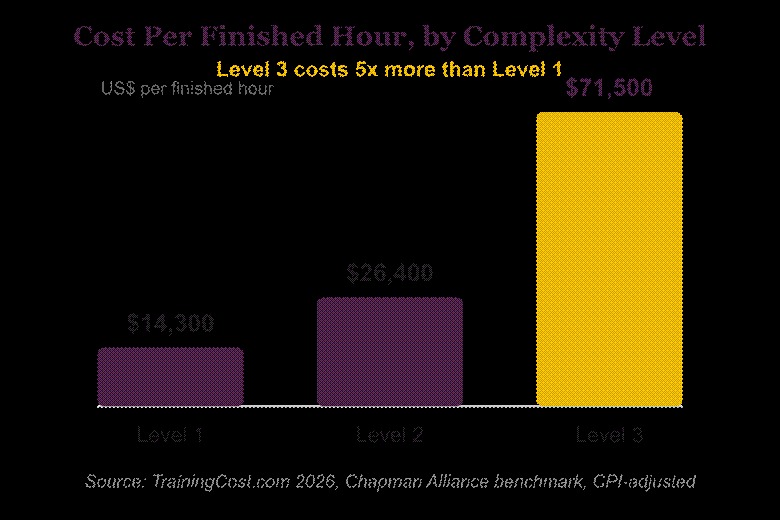
Cost per finished hour by complexity level. Source: TrainingCost.com 2026, Chapman Alliance benchmark.
That rises to roughly $26,400 for interactive or branching content, and up to $71,500 for simulation-level complexity, a five-times spread between the simplest and most demanding tier.
That gap is usually bigger than the difference between any two companies’ day rates, which is why scoping the complexity level honestly matters more than picking a name off this list.
>> Meet the people who would own your engagement before you commit to anything
The Portfolio Review Checklist
Every company on this list will send you sample work. Most samples look impressive on a call. Fewer survive this checklist.
The Portfolio Review Checklist
• Does the sample match your content type? A polished sales-enablement demo tells you nothing about compliance-training instincts.
• Is there a real learner outcome attached, or just a description of what was built?
• Can they name who on the sample project still works there today?
• Does the sample show a design decision, a tradeoff made or a constraint solved, or just a finished screen?
• Is the sample recent, within the last 18 months, or years old?
• Would it survive being shown on a phone, not just a widescreen demo reel?
A company that answers all six honestly is rarer than a company with an impressive-looking portfolio. The two are not the same thing.
Why Who Actually Builds It Still Matters
The assumption is that a strong portfolio means a strong process. The reality is that a portfolio shows you the output, not who was in the room when the decisions were made.
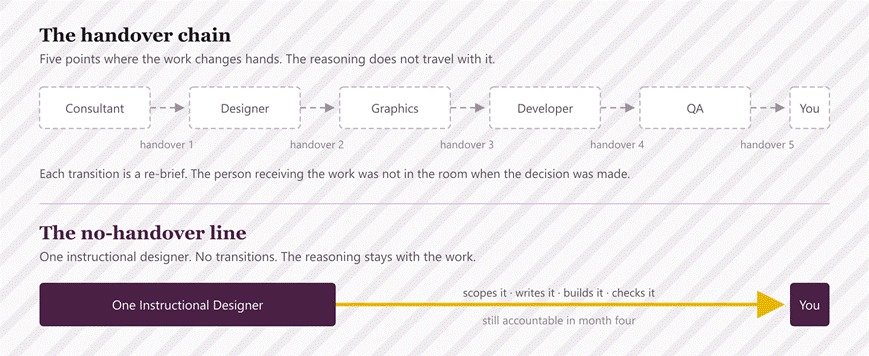
The handover chain versus the no-handover line. Reused verbatim across all four posts.
Inside a conventional production vendor, a designer scopes the work, then hands it to graphics, then a developer, then QA. The portfolio sample you were shown may have passed through all four hands, and the person who made the instructional judgment call may no longer work there, or may not be assigned to your account at all.
That is not dishonesty. It is how most of this category is built and staffed. The question worth asking any company on this list, including us, is how many names it takes to get from your brief to your finished programme, and whether the person behind the sample you liked is the person you will actually get.
What This Doesn’t Include
VonGeyer Consulting does not do everything on this list, and says so before it costs you a wasted call.
Where this doesn’t apply
We are not an LMS vendor and do not administer or configure platforms. We do not run live facilitation, and we do not build native mobile applications. We are a small senior team by design, so a 10,000-seat enterprise rollout in three weeks needs a partner with broader bench capacity than ours. Translation is priced separately, never bundled to make a quote look smaller.
The Question Underneath the List
The question is not which name on this list has the most polished portfolio. It is whether the person behind the sample you liked is the person who will actually build your programme, and whether they are still there to be accountable for it.
Two of the seven companies here already changed ownership once. Review any company’s portfolio against the checklist above before you sign anything.
>> Tell Julian what you’re building and get a direct answer on fit
FAQs
What is the best custom eLearning development company?
There is no single best company. The right choice depends on the complexity of what you are building, whether you need strategy and build from one team or just production capacity, and how the company’s portfolio holds up against a real checklist.
How much does custom eLearning development cost?
Cost per finished hour runs from roughly $14,300 for basic, page-turner content to about $26,400 for interactive or branching content, and up to $71,500 for simulation-level complexity, based on 2026 CPI-adjusted Chapman Alliance benchmarks.
What is the difference between custom eLearning and off-the-shelf courses?
Off-the-shelf courses are pre-built and licensed as-is. Custom development designs and builds training specific to your content, audience and systems, which costs more but fits your actual programme rather than a generic one.
How do I review an eLearning development company’s portfolio?
Check whether the sample matches your content type, whether a real outcome is attached, whether the people who built it still work there, and whether it shows a design decision rather than just a finished screen. The checklist above covers all six questions.
Should I hire an agency or a freelancer for custom eLearning development?
An agency suits programmes needing multiple disciplines, like assessment design, media production and accessibility, coordinated together. A freelancer can suit a single, well-scoped module where one person can reasonably do it all.
What questions should I ask before hiring an eLearning development company?
Who specifically will build it, who checks it, what happens when scope changes, and whether the portfolio sample they showed you was built by someone still on their team.
