
The right curriculum design firm is small enough that one accountable person can hold the whole project. It is also structured enough to hit a real launch date. Curriculum design firms range from a single freelancer to 800-person production agencies, and matching your project to the wrong end of that range turns a six-week build into a quarter in review.
If you are an L&D Manager inside a 12,000-person company, staring down a Q1 compliance deadline with two open requisitions, the vendor you shortlist now is likely the one you hire. 6sense’s 2025 Buyer Experience Report, drawing on nearly 4,000 buyers, found they purchased from a vendor on their Day-One shortlist 95% of the time.
Short answer
Choose a curriculum design firm on three things: who actually writes and builds the course, not just who signs the SOW; whether one accountable person owns the project end to end; and whether their cost per finished hour is transparent enough to compare against a quote. Large production agencies suit programmes above roughly $90,000 needing many specialists at once, solo freelancers suit a single low-complexity course, and a mid-sized Instructional Design House suits the range in between, which is most corporate L&D work.
TL;DR
- Curriculum design firms fall into three tiers: solo freelancers, mid-sized Instructional Design Houses, and large production agencies.
- The single biggest quality signal is whether the person who scopes the project also builds it.
- 95% of the time, the vendor a buyer eventually hires was already on their Day-One shortlist.
- Hiring one instructional designer in-house runs roughly $130,000 fully loaded in year one, before any start delay.
- Almost no firm in this category publishes a scope boundary, so a stated one is a strong trust signal.
- The most common buying mistake is matching firm size to budget instead of to project complexity.
- One question separates the tiers in a single call: how many people touch the course after kickoff?
- A permanent catalogue need usually suits a managed retainer better than a repeated RFP.
>> See what a full engagement actually looked like, from first call to final upload
The Three Tiers of Curriculum Design Firm
Buyers may search for curriculum development companies or training curriculum development providers, but the same three tiers sit behind every label. A one-person freelance practice sits at one end. A large production agency with dedicated graphics, development and QA departments sits at the other. A mid-sized Instructional Design House sits in between, and most corporate L&D work belongs there.
A Director of Programs renewing forty courses on an eighteen-month cycle needs a different tier than a Learning Manager launching one compliance course before March. Team size, not brand size, is what actually predicts fit. The table below separates the three tiers by what you get, not by what the homepage claims.
| Tier | Team size | Best-fit project | Who builds it after scoping | Typical timeline |
| Solo freelancer | 1 person | A single, low-complexity course | The same freelancer, if they have the time | Fast to start, slow if scope grows |
| Instructional Design House | Small senior team | Ongoing catalogue work or one $5,000-$90,000 programme | The same designer who scoped it, end to end | Weeks to a few months |
| Large production agency | 50-800+ people | Multi-specialist programmes above roughly $90,000 | A team the buyer never meets during scoping | Months, with more review cycles |
Why Most L&D Teams Pick the Wrong Tier
The assumption is that a bigger firm is the safer choice. The reality is that a size mismatch creates its own risk, in both directions.
A large agency on a single-course project means paying for coordination a small job never needed. Account management, a separate creative department, and a QA team that reviews work it did not build all add cost without adding speed. A freelancer on a permanent catalogue need means re-running procurement every time that one person is unavailable.
6sense found 94% of B2B buyers use LLMs during a purchase. Ahrefs’ March 2026 study found only 38% of pages cited in Google AI Overviews also rank in the top 10 for that query. A firm’s site has to state its actual mechanism in plain, extractable language, not just rank for the phrase, or it never reaches the shortlist an AI assistant assembles on a buyer’s behalf.
A Learning Manager under deadline pressure rarely has time to interview five firms. Getting the tier right on the first pass, rather than discovering the mismatch at week six, is the actual cost of this decision.
What Actually Happens After You Sign
Ask any curriculum design firm one question: after kickoff, how many people touch this course before it reaches an LMS as a SCORM or xAPI package? In most of the category, the honest answer has four or five names in it.
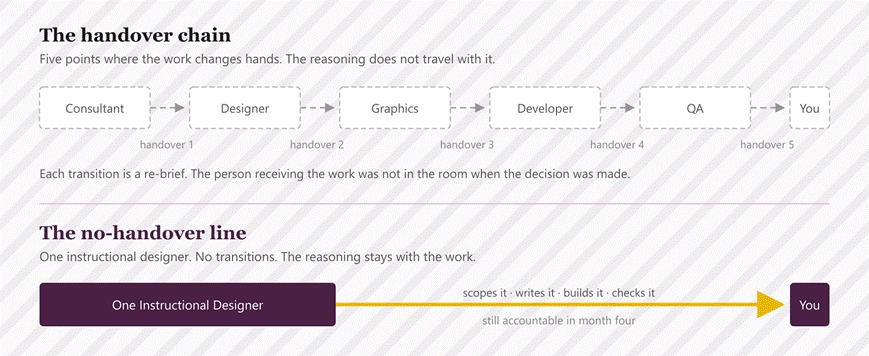
The handover chain versus the no-handover line. Reused verbatim from earlier posts.
The greyed chain above shows the conventional path. A consultant scopes the project, a designer storyboards it, graphics builds the visuals, a developer packages it in Articulate Storyline, and QA checks it before it reaches the buyer. Each arrow is a re-brief, and the person receiving the work was not in the room for the decision behind it.
The gold line below shows the alternative. One instructional designer scopes, writes and builds the course in the authoring tool, checks it personally, and hands it directly to the buyer. Whoever is accountable for quality is the same person who made every design decision.
An L&D Manager comparing two finalist proposals can ask this exact question on the first call, before any SOW is drafted.
>> See who would actually own your engagement before you sign anything
What This Doesn’t Include
An Instructional Design House is not the right fit for every curriculum project, and a firm worth shortlisting says so before you ask. VonGeyer’s September 2026 category research found none of five competitor sites stated a scope boundary.
Where this doesn’t apply
A single senior team cannot absorb a 10,000-seat enterprise rollout that needs five specialists working in parallel this month. Native mobile app development and live, in-room facilitation are outside scope too. Translation is priced and scoped separately, never bundled in.
That silence is the reason a boundary section belongs on a firm’s site before a call. It should not be something a buyer has to extract during one. A scope boundary stated in writing is also easier to hold a vendor to later, if the engagement drifts.
A Director of Programs comparing this against a large agency’s proposal should expect the same candor there. It rarely shows up unprompted.
What This Doesn’t Include, stated plainly
• Not a 10,000-seat enterprise rollout needing five specialists in parallel this month
• Not native mobile app development
• Not live, in-room facilitation
• Translation is priced and scoped separately, not bundled
What It Costs to Get This Wrong
Bringing an instructional designer in-house instead of hiring a firm is not automatically cheaper. That number rarely gets said out loud during a build-vs-buy conversation.
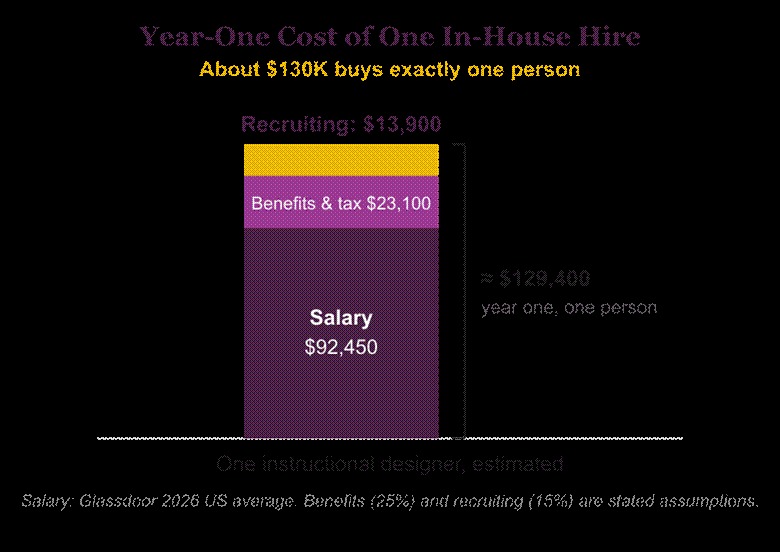
Estimated year-one cost of one in-house hire. Salary: Glassdoor 2026 US average. Benefits (25%) and recruiting (15%) are stated assumptions.
Glassdoor’s 2026 US data puts the average instructional designer salary at $92,450. Add benefits and payroll taxes at an assumed 25% and recruiting at 15% of salary, the low end of the common 15-25% range, and year one costs roughly $130,000. That buys exactly one person, after a search that rarely takes less than a couple of months, and the salary keeps running after the project ends.
A curriculum design firm’s cost per finished hour is comparable across proposals in a way a headcount request never is. That only works if the firm publishes a banded range instead of “contact us for pricing.” A vendor that will not name a range is asking a buyer to compare blind.
This is the number an L&D Manager needs on hand before finance asks why the vendor quote looks larger than a single salary line.
What Good Looks Like
The clearest proof a firm removed the handover, not just claimed to, is a project that shipped faster than the category norm without adding people. VonGeyer Consulting scripted, designed and built 20 hours of learning in 45 days, against a roughly 4-month industry baseline. The same senior designer who scoped the project was still accountable for it in month two.
A Director of Programs choosing between tiers should ask for this exact proof. Not a case study logo, but a timeline with a name attached to every stage of it. If a firm cannot produce one, the coordination layers it is quoting for are still there, whether or not the SOW admits it.
What Changes When You Get the Tier Right
A curriculum design firm sized to the actual project, not to the budget line it was drawn from, is the difference between a course that ships and a course that spends a quarter in revision. For a stretched L&D team running corporate curriculum development, that means capacity that closes the gap between what leadership asked for and what two open requisitions can deliver. It does not mean creating a second coordination job just to manage the vendor.
>> Tell Julian what you’re building and get a direct answer on fit
FAQ
How much does it cost to hire a curriculum design firm?
Most mid-sized firms price a defined project between $5,000 and $90,000, depending on complexity. Managed retainers for ongoing catalogue work run roughly $8,000 to $10,000 a month, and large production agencies typically start above that $90,000 band. Ask for cost per finished hour, not a day rate, to compare proposals fairly.
What’s the difference between a curriculum design firm and a single instructional designer?
A curriculum design firm has more than one person available, which matters once a project needs graphics, development and QA beyond one individual’s skill set. A single freelance instructional designer is often the right choice for one small, low-complexity course, but has no backup capacity if the project grows or they become unavailable.
Should a small L&D team use a freelancer or an agency?
Neither extreme usually fits a stretched enterprise team well. A freelancer suits a single small course, and a large agency adds coordination cost a small team does not need. A mid-sized Instructional Design House, sized for $5,000-$90,000 projects, is built for exactly this range.
How long does a typical curriculum design engagement take?
A single course built by a small senior team typically takes weeks to a few months, depending on complexity and how many SME review cycles it needs. VonGeyer Consulting has scripted, designed and built 20 hours of learning in 45 days against a roughly 4-month industry baseline. Large agency engagements usually run longer because of added review layers.
What questions should I ask before signing with a curriculum design firm?
Ask who builds the course after the person who scoped it hands it off, and whether that is the same person or a different team. Ask what the firm’s cost per finished hour is, and what drives it. Ask what the engagement explicitly does not include, and treat a vague answer as the answer.
Is a managed retainer cheaper than hiring an in-house instructional designer?
A fully loaded in-house hire runs roughly $130,000 in year one, on Glassdoor’s average salary plus assumed benefits and recruiting costs, and buys one person. A managed retainer in the $8,000-$10,000 a month range delivers a dedicated named designer without the recruiting cost or the start delay. It does not build the internal institutional capacity a hire eventually can.
