
Unless your contract says otherwise, the vendor who built your course may own the editable source files. You may hold only the published package that runs in your LMS.
In US law, a contractor’s work generally stays with the contractor unless a signed agreement assigns it. A narrow work-made-for-hire exception also needs a signed agreement.
For a Director of Programs at a certification body inheriting 40 courses from a closed agency, that gap decides whether the catalogue can be updated. Vendor changes become likelier when budgets tighten.
ATD’s 2026 State of the Industry report found 28% of talent development leaders expect more resources, down from 48% a year earlier. This guide is practical, not legal advice.
| eLearning source files (definition) eLearning source files are the editable project, such as a Storyline file or a Rise 360 course, with its scripts, audio, graphics and review comments. The published SCORM or xAPI package is the output. The source files are what let anyone change the course afterwards. |
TL;DR
- Source files are the editable project; the published SCORM or xAPI package cannot be edited.
- It matters to Directors of Programs and L&D Managers who must update courses after a vendor leaves.
- In US law, a contractor’s work generally stays with the contractor unless a signed agreement says otherwise.
- Put five clauses in the contract: ownership, delivery, right to modify, third-party licences and payment tied to delivery.
- Rise 360 courses live in an Articulate 360 account and transfer one course at a time, per Articulate’s community.
- The US Copyright Office’s January 2025 report says prompts alone are not authorship, so ask vendors where humans wrote and checked.
- Collect all three layers of the file set before ending any vendor relationship.
>> See how a 90-hour course was designed, built and delivered into the client’s own LCMS
Table of Contents
- What You Actually Receive at Handover
- What the Law Says by Default
- Five Clauses to Put in the Contract
- Tool Traps: Storyline and Rise
- What to Collect When You Switch Vendors
- What This Doesn’t Include
- FAQ
What You Actually Receive at Handover
A finished course is three layers, and most handovers deliver only the first. The published package plays in your LMS but cannot be edited. The editable source project and the working assets are what let you change the course later.
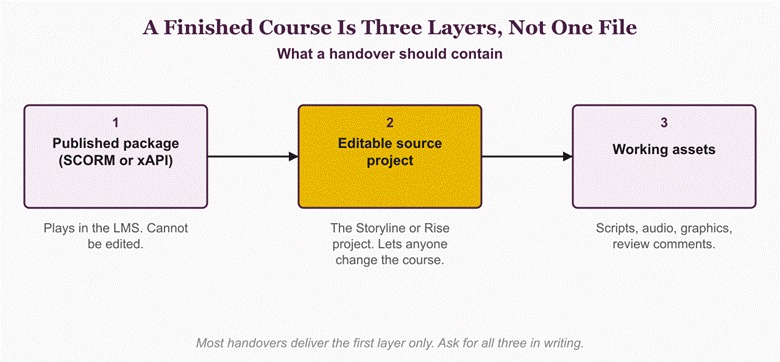
A finished course is three layers: the published package, the editable source project and the working assets. Alt text: Three boxes in a row, the middle box (editable source project) in gold.
The diagram shows three layers. Layer one is the SCORM or xAPI package your LMS runs, and layer two, in gold, is the editable Storyline or Rise project. Layer three is the scripts, audio, graphics and review comments behind them.
A course with only layer one is a closed box. Fixing a single wrong figure then means rebuilding the module, or asking the original vendor for a favour.
What the Law Says by Default
In the US, the person who creates a work owns it unless a written agreement says otherwise. For commissioned work by an independent contractor, the US Copyright Office’s circular on works made for hire explains the exception. It applies only to certain categories of work, and only when both parties sign a written agreement saying so.
Assignment is the usual route. The contract states that the client owns the deliverables on payment, or holds a perpetual licence to edit them. Rules differ outside the US, so ask your counsel before you rely on any default.
AI adds a second question. The US Copyright Office’s Part 2 report, released 29 January 2025, found that prompts alone do not make a user the author of AI output. Human authorship is required, so ask vendors to show where designers wrote and checked each element.
Five Clauses to Put in the Contract
Put the clauses in the statement of work, not in an email. Each one closes a specific gap.
| Clause | What to write | What goes wrong without it |
| Ownership or assignment | The client owns all deliverables on payment, or holds a perpetual licence to edit | The vendor keeps rights and you can only run the course |
| Delivery of source files | Editable projects, scripts, audio and graphics delivered with the final package | You hold a package nobody can change |
| Right to modify | You or any vendor may edit and republish | A new vendor must rebuild from scratch |
| Third-party assets | Licences for stock music, fonts and images are stated and transferable | The course breaks when a licence lapses |
| Payment tied to delivery | The final payment falls due only after all source files arrive | You lose negotiating power at handover |
Source-file ownership is the buyer-scorecard question this table answers. A good vendor will agree to all five without negotiation, because a course the client can maintain is also one that keeps the relationship open.
>> Send us the file-ownership clause from your current contract and get a plain-language read
Tool Traps: Storyline and Rise
The tool you build in changes what “handing over the file” means. Storyline saves a project as a file that can be sent or shared. Rise 360 courses live inside an Articulate 360 account, so a handover is usually a transfer between accounts.
From the desk
Per Articulate’s own community answers, Rise ownership transfers need Articulate 360 Teams accounts on both sides and move one course at a time. Sending a copy gives the new owner a separate copy, not a transfer. Confirm the current rules with Articulate Support before relying on them.
Articulate’s community discussion on transferring Rise courses between accounts shows how often this catches teams out. If you are still choosing a tool, our comparison of Storyline and Rise covers the trade-offs.
What to Collect When You Switch Vendors
Collect the full file set before you end the relationship, and before you stop paying. Ask for these seven items in writing.
- The editable project for every course, in the tool version used.
- Scripts and storyboards.
- Audio files, with the voice licence terms.
- Graphics and fonts, with their licences.
- The SCORM or xAPI package for the live version.
- The review comments and approval log.
- A list of tools and versions used to build each course.
Open one course in the tool yourself before you sign off. A file that will not open is a file you do not have. For white-label resellers the same checklist applies, and our guide to white label course development covers the agreement terms.
What This Doesn’t Include
This guide is a checklist, not legal advice, and VonGeyer is not a law firm. It covers the US default and does not replace your counsel’s review of your own contract.
- It does not cover learner records, which belong to a separate data contract with your LMS vendor.
- It does not cover content built inside a vendor’s proprietary hosted platform, where a source file may not exist.
- It does not settle ownership of AI-assisted material, where the law is still developing.
Where this doesn’t apply
If a vendor authors in a closed platform, ask for an export format and test it before you sign. Outside the US, ownership and moral rights work differently, so check local law. Our position is that you should be able to edit what you paid for, and any statement of work should say so.
What Changes When You Own What You Paid For
A team that owns its source files can fix a figure in a day and move vendors without a rebuild. A catalogue then survives any single supplier leaving. For a Director of Programs, that is the difference between a catalogue and a pile of packages.
>> Talk to Julian about a statement of work that puts source-file delivery in writing
FAQ
Who owns the eLearning course I paid a vendor to build?
It depends on your contract, and in the US a contractor’s work generally stays with the contractor unless a signed agreement assigns it. A narrow work-made-for-hire exception also needs a signed agreement. Put ownership or a perpetual licence to edit in the statement of work.
Can a vendor refuse to hand over source files?
If the contract does not require delivery, yes, a vendor can decline or charge for them. Some vendors sell source files as an add-on. Write delivery of editable files into the contract and tie the final payment to it.
What is the difference between SCORM and source files?
A SCORM or xAPI package is the published output that plays in your LMS and records completion. Source files are the editable project, such as a Storyline file or a Rise course, from which the package is made. Without the source, you can run the course but not change it.
How do I transfer a Rise 360 course to a new vendor?
Rise courses live in an Articulate 360 account. Per Articulate’s community answers, ownership can transfer between Teams accounts one course at a time, and an admin can move all of a member’s courses. Check current rules with Articulate Support, because a sent copy is not a transfer.
Do AI-generated course materials have copyright protection?
In the US, the Copyright Office’s January 2025 report concluded that prompts alone do not make a user the author of AI output. Human authorship is required for protection. Ask your vendor to show where designers wrote, selected and checked each element.
