
Compliance training fails when it is built to be completed rather than to change a decision employees make at work. A course that recites policy passes the LMS completion check and leaves the risky behaviour exactly where it was.
For a Head of Learning at a bank or a law firm, that gap is now a regulatory question, not only a design one.
Employees notice it first. A TalentLMS survey of 1,000 US workers was reported by HR Dive in February 2026. 45% said their compliance training is disconnected from the real situations they face.
The fix is not a brighter course. It is a course designed around the few decisions where people actually go wrong.
| Why compliance training fails (definition) Compliance training fails when it measures completion instead of behaviour. Courses that restate policy, without practising the specific decisions where misconduct happens, produce high completion rates and unchanged conduct. Effective compliance training is built around those decisions and measured by what people do afterwards. |
TL;DR
- Compliance training fails because it is designed for completion, not for the decisions where misconduct happens.
- It matters most to Heads of Learning and compliance training leads in banks, lenders and law firms.
- 45% of US workers say their compliance training is disconnected from real situations.
- The US Justice Department now asks whether training has an impact on employee behaviour.
- Making a course more entertaining rarely helps; practising the risky decision does.
- A redesign starts with three to five decisions, not with the policy document.
- What a design partner does not include matters as much as what it does.
>> See how one engagement was scoped, built and delivered by the same team
Table of Contents
- Why High Completion Rates Hide the Problem
- Why Making It More Engaging Rarely Works
- What Regulators Now Ask About Your Training
- How to Redesign a Compliance Course Around Decisions
- What This Doesn’t Include
- Custom or Off-the-Shelf Compliance Courses: Where Each Fits
- FAQ
Why High Completion Rates Hide the Problem
High completion rates hide the problem because completion measures attendance, not judgment. A 98% completion figure tells a compliance committee that people clicked through. It says nothing about whether a relationship manager would spot a suspicious transaction next week.
The same survey shows the split. Most workers believe the training helps, yet nearly half say it does not match their real situations. One in five said they received no compliance training at all in the last year.
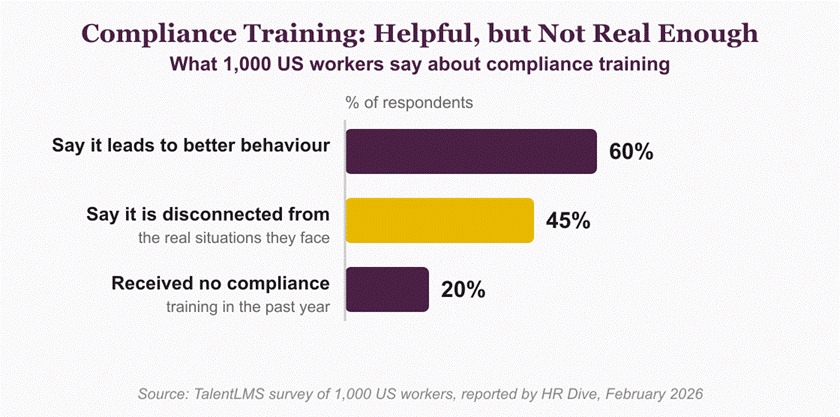
What 1,000 US workers say about compliance training: 60% say it leads to better behaviour, 45% say it is disconnected from real situations, 20% received none in the past year. TalentLMS survey reported by HR Dive, February 2026. Alt text: Horizontal bar chart with the 45% disconnected bar highlighted in gold.
The chart shows three findings from the TalentLMS survey of 1,000 US workers. 60% say compliance training leads to better behaviour at work.
45% say it is disconnected from the real situations they face. 20% received no compliance training in the past year.
Source: [HR Dive, reporting TalentLMS survey data, February 2026](https://hrdive.com/news/employees-say-compliance-training-disconnected-from-real-life/811026)
For a compliance training lead at a lender, the 45% is the number to act on. It points to the specific design failure: generic content that never reaches the employee’s actual decisions.
Why Making It More Engaging Rarely Works
The assumption is that compliance training fails because it is boring. The reality is that it fails because it trains the wrong thing.
The usual response is a format upgrade: animation, gamification, a shorter video. Those can help attention. But if the course still restates the policy, people finish a livelier version of the same irrelevance.
The deeper cause is how these courses get made. Legal writes the policy summary, a vendor’s designer storyboards it, a developer builds it and a reviewer checks the wording. No one in that chain owns the question of what the learner must decide differently.
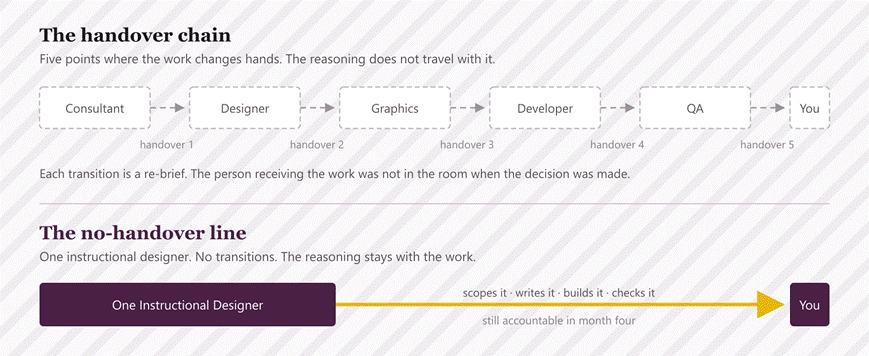
The handover chain versus the no-handover line. Reused verbatim from earlier posts. Alt text: Four-step handover chain from instructional designer to graphics to developer to QA to you, shown greyed and dashed, above a single unbroken gold line from instructional designer straight to you.
The greyed chain above shows the usual path, from designer to graphics to developer to QA, then to you. The gold line below shows the alternative, where the designer who scoped the decisions also builds and checks them. Intent survives because nobody has to re-brief it.
A Head of Learning at a law firm sees the result in the review cycle. The course is accurate, signed off and published, and it changes nothing about how associates handle a conflict check.
What Regulators Now Ask About Your Training
Regulators now ask whether training changed behaviour, not only whether it was delivered. The US Justice Department’s guidance on evaluating corporate compliance programmes, updated in September 2024, puts the question directly.
“Has the company evaluated the extent to which the training has an impact on employee behavior or operations?”
Source: [US Department of Justice, Criminal Division, Evaluation of Corporate Compliance Programs (Updated September 2024)](https://www.justice.gov/criminal/criminal-fraud/compliance)
The same guidance asks whether training is tailored to high-risk employees and whether it covers lessons from past incidents. That is a design brief, not a completion target.
Most functions are not ready to answer it. ATD’s 2026 State of the Industry report found that less than a quarter of organisations measure whether their training achieved its organisational goals.
| What most teams report | What a regulator now asks | What to measure instead |
| Completion rate | Has training changed behaviour? | Error or breach rates in the trained decision |
| Quiz pass rate | Have employees learned the subject matter? | Scenario performance on realistic cases |
| Hours delivered | Is training tailored to high-risk roles? | Coverage of each high-risk role |
| Annual refresh done | Does training cover past incidents? | Incidents reflected in the next version |
How to Redesign a Compliance Course Around Decisions
A compliance redesign starts with the three to five decisions where misconduct actually happens, then builds practice around each one. The policy document becomes reference material, not the course.
A compliance training lead at a bank can run the first four steps with their risk team before any vendor is involved.
- List the decisions where breaches occurred or nearly occurred in the last two years.
- Map each decision to the roles that make it, so high-risk roles get their own path.
- Write one realistic scenario per decision, with the wrong answer as tempting as it is in real life.
- Agree one behaviour signal per decision, such as escalations raised or exceptions logged.
- Build the scenarios, publish to the LMS as SCORM or xAPI, and test tracking before launch.
- After every incident, add it to the next version of the course.
Measurable outcomes is the buyer-scorecard question this section answers. A course designed this way can report on behaviour signals, not just completions.
VonGeyer Consulting is a registered supplier to Bajaj Finance and Kennedys Law, both in sectors where compliance training carries regulatory weight.
>> Tell Julian which decisions your course needs to change, and get a straight answer on scope
What This Doesn’t Include
A compliance redesign from VonGeyer covers the learning design and the build. It deliberately leaves out several things buyers sometimes assume are bundled.
- Legal advice or interpretation of the regulation. Your legal or compliance team owns that.
- Writing or rewriting the policy itself. We design training around a policy you have approved.
- An off-the-shelf course library or annual licences. We build courses you own.
- LMS hosting or administration. We deliver into your LMS and test that tracking works.
- Translation, which is priced separately when needed.
Stating this up front protects the compliance lead. Gaps found mid-project cost more than gaps agreed at the start.
Where this doesn’t apply
If your need is a broad library covering twenty standard topics for every employee, a licensed off-the-shelf catalogue will usually serve you better. Custom design pays off for the few high-risk decisions where generic content fails. VonGeyer is not a 10,000-seat rollout vendor for this month.
Custom or Off-the-Shelf Compliance Courses: Where Each Fits
Off-the-shelf courses fit broad, stable topics that every employee needs. Custom compliance training fits the high-risk decisions that are specific to your products, clients or jurisdiction.
Most organisations need both. A Head of Learning at a lender might license general data-protection training and commission custom scenarios for loan exception handling.
| Point to check | Off-the-shelf course | Custom compliance course |
| Best for | Broad, standard topics for all staff | High-risk, role-specific decisions |
| Scenarios | Generic workplace examples | Your products, cases and past incidents |
| Speed to launch | Days | Weeks to months |
| Ownership | Licensed, renewed each year | You own the course and source files |
| Behaviour measurement | Completion and quiz scores | Scenario performance and agreed signals |
| Updates after an incident | Vendor’s schedule | Yours, built into the next version |
The useful question is not custom or off-the-shelf. It is which decisions are worth designing for, and which can be covered by a library.
What Changes When Training Targets the Decision
Compliance training that targets the decision gives a Head of Learning something completion rates never could: evidence that conduct changed. For a stretched L&D team, it also means fewer courses to maintain, because each one does a specific job.
>> Talk to Julian about redesigning the compliance course your regulator is most likely to ask about
FAQ
Why is compliance training important?
Compliance training helps employees recognise and avoid conduct that creates legal, financial or reputational risk. It also gives an organisation evidence that it tried to prevent misconduct, which regulators and prosecutors consider when assessing a compliance programme.
What happens if an employee is not properly trained?
An untrained employee is more likely to make the decisions that lead to breaches, fines or client harm. For the organisation, weak training can also count against it when regulators assess whether its compliance programme was effective.
Why is lack of training a problem?
Without training, employees fall back on habit or guesswork in situations where the rules are specific. The problem grows in regulated roles, where one wrong decision can trigger an investigation, a penalty or a lost client.
What are the 7 pillars of compliance?
The seven elements usually cited come from the US Federal Sentencing Guidelines. They are written standards, oversight, due diligence in delegating authority, training and communication, monitoring and auditing, consistent enforcement, and response to violations. Training is one pillar, and it supports all the others.
How do you measure whether compliance training works?
Agree one behaviour signal for each decision the course targets, such as escalations raised or exceptions logged. Compare that signal before and after the course, alongside scenario performance. Completion rates alone show attendance, not effectiveness.
