
Outsource instructional design when the work is bounded, the deadline is fixed, and the design judgment the programme needs is not sitting in your building. Do not outsource it when the content changes weekly, when nobody internally can approve a storyboard, or when what you actually need is one permanent hire.
Most guides on this question are written to move you toward a yes. This one helps a Head of Learning decide correctly, including the cases where the answer is no. The pressure is measurable: ATD’s 2025 State of the Industry found formal learning hours used per employee fell from 17.4 to 13.7 in a single year, while the cost per hour rose sharply over the same period.
The situation is familiar: two instructional designers, eleven programmes queued, compliance overdue, a product launch with a date attached. Nobody is underperforming. The arithmetic does not work.
Short answer
Outsourcing instructional design is the right call when you have a defined programme, a fixed deadline, and a capability or capacity gap you cannot close in time. It is the wrong call when requirements are still moving, when no internal owner can make design decisions, or when the need is permanent rather than peaked. The decision that matters is not vendor versus vendor. It is whether you are buying accountability or just buying hands.
TL;DR
- Outsourcing suits bounded scope, fixed deadlines, and specialist gaps. It does not suit unstable requirements.
- The trigger is rarely raw capacity. It is usually a capability the team does not have and cannot hire in time.
- The real alternative to a partner is a job requisition: roughly $115,000 to $130,000 fully loaded, and six to twelve weeks before anyone starts.
- Cost per learning hour rose 34% in a single year while hours delivered per employee fell. Buying more hands does not fix that.
- Most outsourcing disappointment traces to handovers inside the vendor, not to the decision to outsource.
- Eight questions will tell you whether a firm is a design partner or a production shop.
- Four situations where you should keep the work in-house, stated plainly.
>> See the 90-hour engagement this rubric is built from, start to finish
The Real Trigger Is Rarely a Capacity Shortfall
Ask an L&D Manager why they are considering an outside team and the first answer is almost always volume: too many programmes, not enough people. That is true, and rarely the whole reason.
Look at what sits in the queue and a second pattern shows up. The compliance refresh is stalled because nobody has run a WCAG 2.2 pass before. The certification programme is stalled because writing assessment items to a blueprint is a specialist skill.
That is a capability gap wearing a capacity gap’s clothing, and the two have different fixes. Capacity gaps close with more hands. Capability gaps close only when someone who has done the work before makes the design decisions.
The Assumption Is Capacity. The Reality Is Accountability.
The assumption across most vendor guidance is that outsourcing is a capacity decision: you lack people, a partner supplies people, the queue clears. The reality is that outsourcing is an accountability decision, and that is where most disappointment originates.
Consider a conventional production vendor. A designer scopes your programme and writes the storyboard. A graphics team styles it. A developer builds it. A QA function checks it against a template. By round three of review, nobody still on the project attended the first meeting.
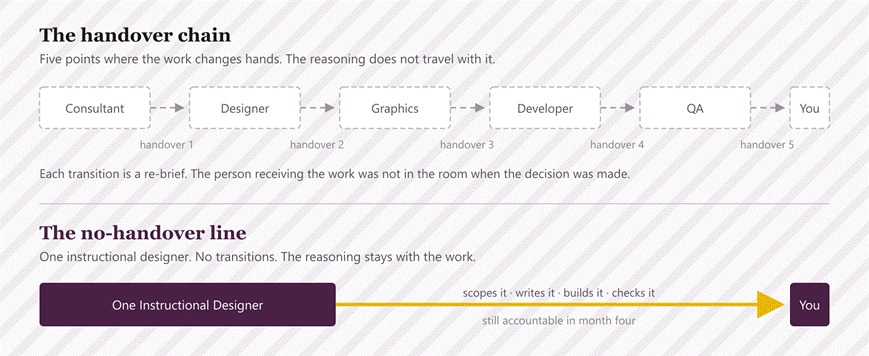
The handover chain versus the no-handover line. Reused verbatim from post 2 and homepage module M5.
You did not remove the coordination cost. You moved it across a contract boundary, where you have less visibility and no authority. This is why two firms quoting similar numbers produce different experiences: one is selling you capacity, the other a person still accountable in month four. The test is simple. Ask who will do each stage. Four different names means you bought a chain, not a partner.
A Partner Versus a Job Requisition
For ongoing catalogue work, the real alternative is not another vendor. It is a job requisition. Almost nobody puts the two side by side, so here is the arithmetic.
| Hiring one instructional designer | A managed design team | |
| Fully loaded annual cost | approx. $115,000-$130,000 | Monthly retainer, ends when you end it |
| Time to first output | 6-12 weeks to hire, then ramp | Weeks |
| People on the work | One | Two to four, by discipline |
| When the programme ends | The salary continues | The engagement stops |
| Range of skills | One person’s | Scripting, media, assessment, accessibility |
Fully loaded means salary plus benefits, payroll taxes, recruitment at 15-25% of first-year salary, and overhead (Glassdoor 2026, Robert Half 2026, US BLS).
+10.8% projected growth, approx. 46,000 openings a year
The BLS projects training and development specialist employment to grow 10.8% through 2034, well above the average for all occupations. Six to twelve weeks to hire is an optimistic assumption in that market, not a safe one.
Source: US Bureau of Labor Statistics, Occupational Outlook Handbook
Four Conditions That Make Outsourcing the Right Call
Outsourcing works when all four are true. When two or more are false, reconsider.
- The scope is bounded and someone can describe roughly what the programme must change.
- The deadline is real and external: a regulatory date, a launch, a licensure cycle. Internal target dates slip and take the budget with them.
- The capability gap is genuine: assessment design, accessibility remediation, audio-first design, LCMS delivery. Something your team would be learning on your deadline.
- One internal owner can approve a storyboard without convening a committee. This single condition predicts more outcomes than budget does.
When these hold, speed follows: one of our own programmes had 20 hours of learning scripted, designed and built in 45 days, against an industry baseline of roughly four months for that scope.
>> See who would actually own your engagement before you sign anything
The Squeeze on Every L&D Team Right Now
Two figures make the arithmetic concrete for anyone weighing this decision.
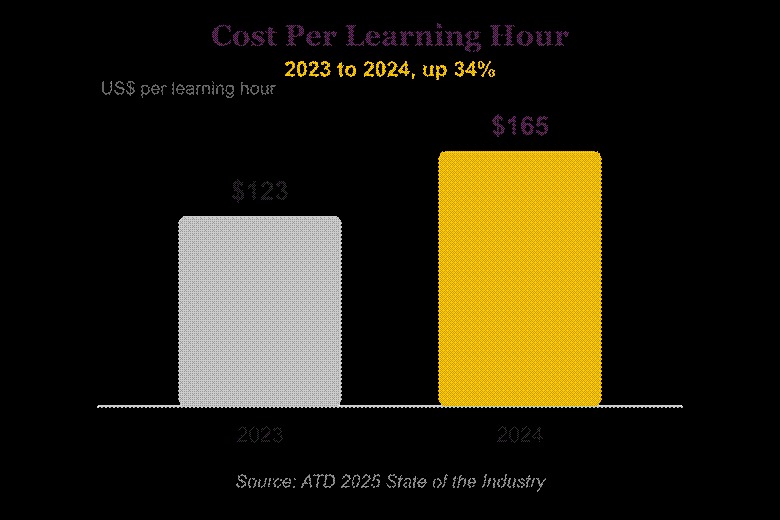
Cost per learning hour, 2023 to 2024. Source: ATD 2025 State of the Industry.
The average cost per learning hour used rose to $165 in 2024, a 34% jump from $123 the year before.
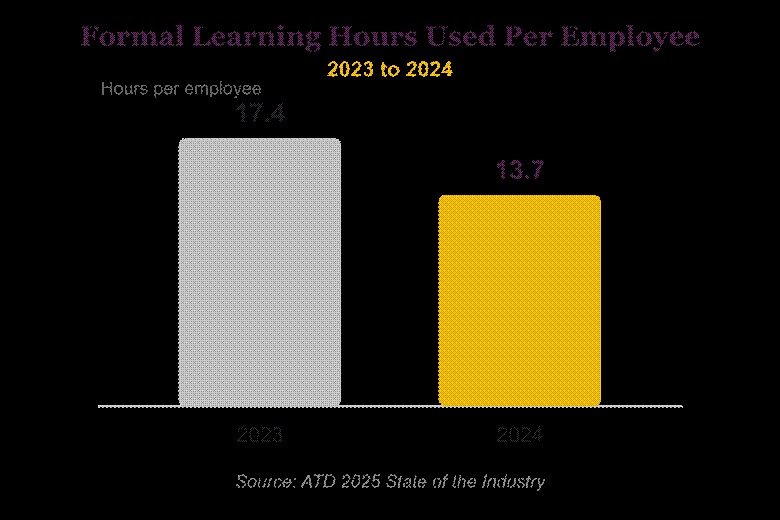
Formal learning hours used per employee, 2023 to 2024. Source: ATD 2025 State of the Industry.
Formal learning hours used per employee moved the other way, falling from 17.4 to 13.7. Organisations spent more and delivered less of it, which is the case for buying judgment rather than raw throughput.
Questions to Ask Any Learning Partner
This is the rubric we would want you held to. It works on any firm, including ours, and a handover-model vendor will struggle with at least three.
- Who specifically will design this, and who will build it? A weak answer is “our team of designers.”
- Is that the same person? If not, how many times does the work change hands?
- Who checks it, and against whose written standard?
- What exactly does AI do here, and what does it not do?
- Who owns the source files, the Storyline or Rise project, not just the published SCORM package?
- What happens when scope changes in week six? Ask for the mechanism, not the reassurance.
- What will you not do? A firm that cannot name its boundary has not thought about it.
- What is the cost per finished hour, and what moves it, not a rate card?
The first three are one question in three forms, and they matter most: most of what a buyer worries about after signing traces back to how many times the work changed hands.
When You Should Not Outsource
Four situations where an outside team makes things worse. We would rather say this on a first call than three months in.
- Your requirements are still moving. No vendor can absorb subject matter changing weekly.
- Nobody internally can approve. If every storyboard needs three sign-offs across two time zones, external speed cannot help you.
- The need is permanent and predictable. A hire, not a partner, is what steady baseline demand is for.
- The knowledge cannot leave the building. Some content is too operationally specific to transfer efficiently. Say so early.
Where this doesn’t apply
We are not an LMS vendor and do not administer platforms. We do not run live facilitation. Translation is priced separately, never bundled to make a quote look smaller. If your problem is platform configuration rather than design, a partner like us is the wrong spend.
What It Looks Like When the Decision Was Right
A US real-estate school came to us with one question: could we improve their students’ pass rates. Their pre-licensure programme ran 90 hours and was entirely audio, for adults changing careers in whatever time they had.
The obvious move was more video. We did the opposite: these learners studied in cars, which ruled video out. The programme was rebuilt audio-first, in short segments with spoken recaps and quizzes mirroring the actual state exam. Ninety hours, rebuilt in five months, into the client’s own LCMS.
That decision was made by the designer who then built it. It did not survive a handover, because there was not one.
The Question Underneath the Question
The question is not whether to outsource. It is whether the firm you are considering will still be accountable for the work in month four, and whether you can name the person who will be.
>> Tell Julian what you’re building and get a direct answer on fit
Frequently Asked Questions
When should you not outsource instructional design?
Keep the work in-house when requirements are still changing, no internal owner can approve design decisions, volume is steady and permanent, or the subject knowledge is too operationally specific to transfer.
How much does it cost to outsource instructional design?
Usually priced per finished hour of learning. US agency rates commonly fall between $100 and $150 an hour, varying with interactivity, media complexity, review rounds, and accessibility standard.
Is outsourcing instructional design the same as staff augmentation?
No. Staff augmentation places contractors under your management, so you carry the accountability. Outsourcing hands a defined scope to a partner who remains accountable for the outcome.
What is the difference between instructional design consulting and outsourced development?
Consulting answers what to build, typically producing a needs analysis or a build estimate. Outsourced development produces the finished learning itself.
Who owns the source files when you outsource instructional design?
That depends entirely on the contract. Ask explicitly for the editable project files, not only the published SCORM package, or you cannot update the content later.
How long does it take to onboard an outsourced instructional design team?
A well-scoped engagement usually moves from first call to active design work within weeks. The variable is rarely the vendor; it is how fast you supply source content and a named approver.
