
An instructional design consultant diagnoses a learning or performance problem and recommends what to build, without necessarily building it themselves. The role is analysis and structure, not production, and confusing the two is the most common reason a consulting engagement disappoints.
LinkedIn’s 2025 Workplace Learning Report found 49% of L&D professionals agree their executives doubt employees have the skills to execute business strategy, which is exactly the question a consultant is hired to answer with evidence rather than opinion.
This page covers what the role actually delivers, how it differs from an instructional designer who builds, and four signs you need one rather than a hire or a full build partner.
Instructional design consultant (definition)
An instructional design consultant is hired to diagnose a workforce learning or performance gap and recommend a structured response: a needs analysis, a skills or competency gap map, a curriculum structure, and a measurement plan. The role is advisory. In most engagements the consultant does not build the finished course, and the contract should say plainly who does.
TL;DR
- An instructional design consultant diagnoses a learning or performance problem and recommends a structured response. Building the finished course is usually a separate scope.
- Standard deliverables are a needs analysis, a skills gap map, a curriculum structure and a measurement plan, not finished learning.
- A consultant and an instructional designer who builds are different roles, and conflating them is the most common source of scope confusion.
- Four signs tell you whether you need a consultant, a build partner, or both from one accountable team.
- Even a pure consulting engagement should pass a version of the No-Handover Check: who did the analysis, and are they accountable for whether it gets used.
>> See what a full engagement actually looked like, from first call to final upload
What an Instructional Design Consultant Actually Delivers
A consultant investigates why a performance or learning problem exists, then tells you what, if anything, should be built to fix it. Standard deliverables: a needs analysis, a skills or competency gap map, a recommended curriculum structure, and a measurement plan.
Some engagements add a governance model or a competency framework. What almost none include is the finished learning itself. That distinction sounds obvious written down, and gets lost constantly inside a proposal, where “instructional design services” can mean a document or a delivered course.
Consultant vs. Designer, at a Glance
The two roles get blurred because the same person sometimes does both. They are still different jobs.
| Role | What They Produce | Are They the One Who Builds It? |
| Instructional design consultant | A needs analysis, gap map, curriculum structure, measurement plan | Usually not – the plan is the deliverable |
| Instructional designer | Storyboards, the finished course, assessments, facilitator guides | Yes – the build is the deliverable |
| An Instructional Design House | Both, from one accountable team | Yes – the same person who analyzed it also builds it |
A Typical Engagement, Step by Step
- Discovery: interviews with stakeholders and a sample of the target learners, plus a review of any existing content.
- Gap analysis: separating what people don’t know from what they know but don’t do, since the fixes for each are different.
- Recommendation: a curriculum structure and delivery approach, usually with a build estimate attached.
- Measurement plan: what gets measured, against what baseline, before anything is built.
Do You Need One? Four Signs
Not every learning problem needs a consultant first.
| Sign | What It Looks Like in Your Team |
| Nobody can say why the training isn’t working | You have a course and disappointing results, but no diagnosis |
| Leadership is asking for evidence, not activity | A consultant’s analysis is more defensible than an internal opinion |
| You are about to fund a build you can’t yet describe | Scoping first is cheaper than rebuilding after the first pilot |
| Requirements keep shifting between conversations | A structured needs analysis forces the ambiguity into the open |
If none of these apply, and you already know exactly what to build, a consultant adds a scope and a cost you don’t need. Go straight to a build partner instead.
Where this doesn’t apply
If you can already describe the programme, audience, standard and deadline with confidence, you have effectively done the consulting yourself. Paying for a formal diagnosis at that point adds weeks without adding a decision.
The No-Handover Check, Applied to Consulting
The same five-question test we would want asked of any full build applies just as much to a pure consulting engagement, because a recommendation nobody builds is not a smaller version of success. It is a different kind of failure.
The No-Handover Check, for a consulting engagement
- Who did the analysis? Name and years of experience.
- Who wrote the final recommendation, the same person or a different one?
- Who is accountable if the recommendation is technically sound but operationally unworkable?
- What happens to the analysis if you decide to build with a different partner?
- Does the same person who diagnosed it stay involved through the build, or hand off entirely?
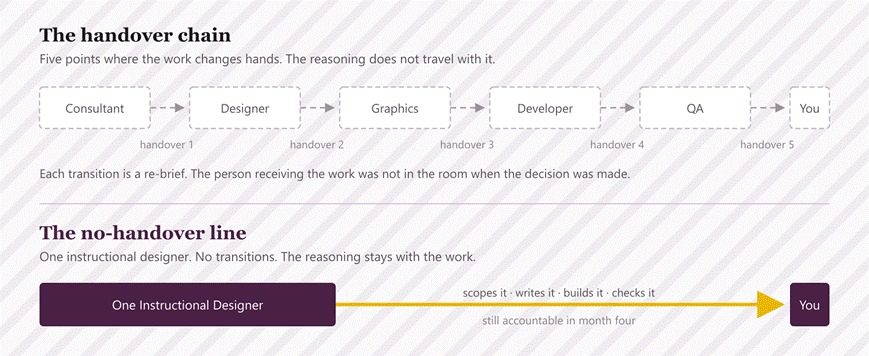
The handover chain versus the no-handover line. Reused verbatim a sixth time across posts.
On a conventional consulting engagement, the analyst who ran the interviews is often not the person who writes the final report, and neither is typically involved once a build partner is selected. Each handover is a chance for the original reasoning to get diluted before anyone builds anything.
>> Meet the people who would own your engagement before you commit to anything
The Question Underneath the Question
The question this role answers is not whether training would help. It is whether the problem is actually a training problem, and what specifically should change if it is.
A recommendation nobody builds is not a smaller win. It is the same failure as a course nobody needed.
>> Tell Julian what you’re building and get a direct answer on fit
Frequently Asked Questions
What does an instructional design consultant do?
Diagnoses why a workforce learning or performance problem exists and recommends what, if anything, should be built to address it. Typical deliverables are a needs analysis, a skills gap map, a curriculum structure and a measurement plan.
Is an instructional design consultant the same as an instructional designer?
No. A consultant’s deliverable is the analysis and plan. An instructional designer’s deliverable is the finished course. Some firms and individuals do both, but the two scopes should still be priced and described separately.
Do I need an instructional design consultant or an instructional designer?
If you cannot yet describe what should be built, start with a consultant. If you can already describe the programme, audience, standard and deadline, you need a designer or build partner, not a diagnosis.
What are the standard deliverables of an instructional design consulting engagement?
A needs analysis, a skills or competency gap map, a recommended curriculum structure, and a measurement plan. Some engagements add a governance model or competency framework.
How much does instructional design consulting cost?
Consulting is usually priced by scope and duration rather than by deliverable, and varies widely with the size of the programme under review. Build work, once scoped, is typically priced per finished hour of learning.
