
Rapid eLearning development builds a course in weeks by combining template-driven authoring tools, existing content and a capped review process. It works when the content is stable and information-led, and it fails when the learning depends on custom simulation or unresolved subject-matter debate.
For an L&D Manager with a Q1 deadline and two open requisitions, the question is which of those two situations you are in.
TalentLMS’s 2026 L&D report surveyed US employees and HR managers in September 2025. It found 53% of employees and half of HR managers say high workloads leave little room for training.
Speed is not a luxury for that team. It is the only way the course gets used.
| Rapid eLearning development (definition) Rapid eLearning development is a way of building courses in weeks. It uses template-driven authoring tools such as Articulate Rise 360, existing source content, one accountable subject-matter expert and a fixed number of review rounds. It suits stable, information-led content, and it is a different scope from custom eLearning, not a weaker version of it. |
TL;DR
- Rapid eLearning development builds courses in weeks from existing content, template-driven tools and capped review.
- It suits L&D Managers and catalogue owners with stable, information-led content and a hard deadline.
- Authoring tools shorten build hours, but handovers and review waits are what stretch the calendar.
- At Level 1 complexity, 20 hours of finished learning is about 1,580 production hours, roughly nine months of one designer’s year.
- The fastest rapid projects fix scope, name one approving expert and cap review rounds before the build starts.
- Rapid is the wrong call for safety-critical training, custom simulations and content still being argued over.
- Five questions put to any partner before you sign show whether their speed is real.
>> See what a full engagement actually looked like, from first call to final upload
Table of Contents
1. What Rapid eLearning Development Actually Means
2. Where the Time Really Goes
3. When Rapid Development Is Worth It
4. What Rapid Development Costs
5. Questions to Ask Any Learning Partner Before a Rapid Build
6. Where Rapid Is the Wrong Call
7. What Good Looks Like
8. FAQ
What Rapid eLearning Development Actually Means
Rapid eLearning development builds a course in weeks. It starts from existing content, uses template-driven tools such as Articulate Rise 360, and limits review to a fixed number of rounds. The speed comes from scope discipline, not from skipping instructional design.
The authoring tool is only one part of that. An L&D Manager who buys new Storyline seats and changes nothing else gets the same calendar in a faster wrapper.
Rapid is also not a synonym for low-effort. A rapid build still needs a storyboard, an SME sign-off and an LMS test in SCORM or xAPI before launch.
Older linear models such as ADDIE finish each phase before the next starts. Rapid projects run iterative cycles, closer to the Successive Approximation Model (SAM). The table sets rapid beside custom eLearning on the points a buyer can check.
| Criterion | Rapid eLearning development | Custom eLearning development |
| Best for | Compliance updates, onboarding, product knowledge | Simulations, branching scenarios, high-stakes skills |
| Starting point | Existing slides, documents, recordings | A blank brief and a full needs analysis |
| Interactivity | Template blocks, knowledge checks | Custom logic, scenarios, bespoke media |
| Review | One approving SME, capped rounds | Multiple stakeholders, staged sign-offs |
| Main risk | Scope creep turns it into a slow custom build | Cost and calendar time |
| Typical tools | Rise 360, template-based Storyline 360 | Storyline 360 with variables and JavaScript, custom media |
Where the Time Really Goes
The assumption is that rapid means a faster authoring tool. The reality is that tools shorten build hours, while handovers and review waits stretch the calendar.
A conventional project passes through a scoping consultant, a storyboarding designer, a graphics team, a developer and a QA reviewer. Each handover is a re-brief, and each re-brief waits in someone’s queue. A Director of Programs refreshing forty courses feels those queues as months, not hours.
The Chapman Alliance’s 2010 study of 249 completed surveys puts a Level 1 finished hour at about 79 development hours. TrainingCost.com republished the figures and re-verified the Level 1 and Level 3 ones in June 2026. That is about two working weeks of one designer’s time.
Treat that as an illustration, not a measured average. If a one-hour course still takes a quarter to ship, most of those weeks were queue time.
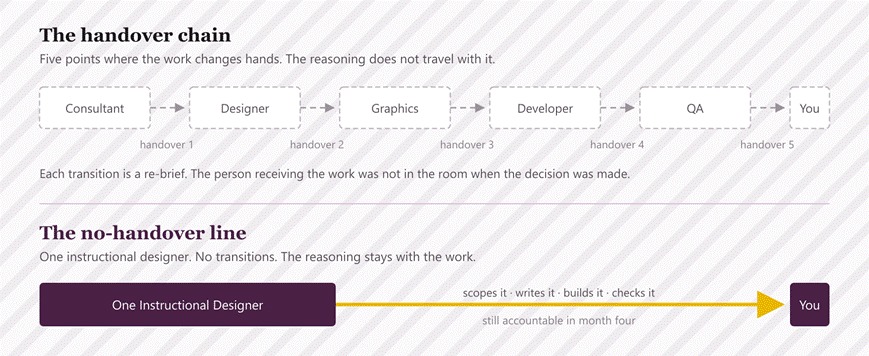
The handover chain versus the no-handover line. Reused verbatim from earlier posts. Alt text: Four-step handover chain from instructional designer to graphics to developer to QA to you, shown greyed and dashed, above a single unbroken gold line from instructional designer straight to you.
The greyed chain above is the conventional path, from instructional designer to graphics to developer to QA and finally to you. The gold line below it is the alternative. The designer who scoped the work builds and checks it.
TalentLMS also found 88% of HR managers expect generative AI to affect the time needed to create learning content. AI can draft faster, but it cannot shorten a review queue.
When Rapid Development Is Worth It
Rapid development is worth it when the content is stable, one expert can approve it, and the learner needs information more than practice. It is the wrong choice when any of those three fails.
A compliance manager refreshing annual policy training is the classic fit. A team building a negotiation simulation is not. Four tests decide the call before any tool is chosen, and you should answer them in writing with your SME, not in a kickoff meeting.
- Is the source content stable, with no open policy questions? If not, wait.
- Can one named SME approve every review round? If not, rapid will slow down.
- Does the learner mostly need to know, not practise? If not, choose custom.
- Can the review rounds be capped in writing? If not, scope will creep.
Each test protects one thing rapid depends on: settled content, a single approver and a fixed number of review rounds. A Director of Programs with forty stable compliance modules passes all four. A team still debating policy wording fails the first, and the calendar drifts back toward custom-build length.
What Rapid Development Costs
Rapid development usually costs less than custom because it sits at the lower complexity levels, where fewer production hours go into each finished hour. TrainingCost.com adjusts the 2010 Chapman figures for inflation, about 42% using the BLS CPI-U. That puts a Level 1 page-turner at about $14,300 per finished hour and a Level 2 interactive course at about $26,400.
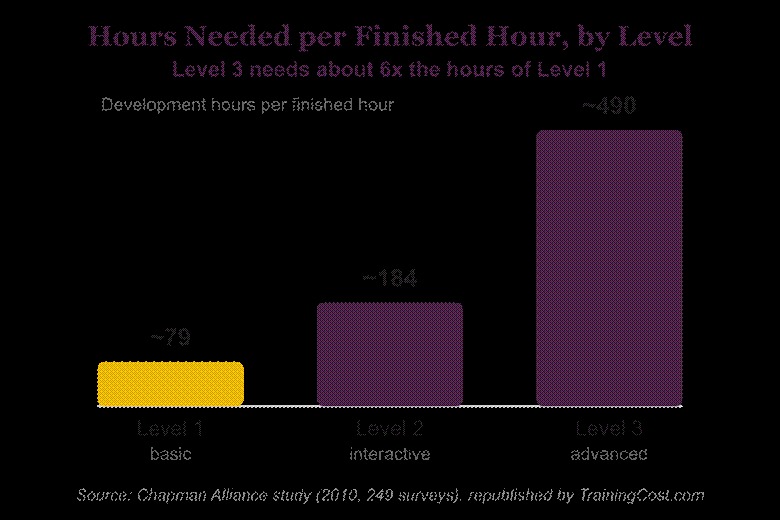
Development hours needed per finished hour of eLearning: about 79 at Level 1, 184 at Level 2, 490 at Level 3. Chapman Alliance study (2010, 249 surveys), republished by TrainingCost.com. Alt text: Bar chart of development hours per finished hour at three complexity levels, Level 3 about six times Level 1.
The chart shows development hours per finished hour at three levels: about 79, 184 and 490. A Level 3 simulation needs roughly six times the hours of a Level 1 build. Rapid development sits at the left of the chart, and the ceiling sits at the right.
Here is a calculation worth doing before any quote arrives. At the Level 1 ratio, a 20-hour catalogue needs about 1,580 production hours. One designer working a 2,080-hour year would need roughly nine months, if nothing ever waited.
An L&D Manager comparing two rapid quotes should convert both to cost per finished hour first.
Questions to Ask Any Learning Partner Before a Rapid Build
A partner’s answers to five questions show whether their speed comes from fixed scope or from hope. A handover-model firm fails at least three. A Director of Programs shortlisting partners should put all five to each of them in writing.
- Is the person who scoped the course the person who builds it?
- How many review rounds are in the fixed price, and what does round four cost?
- Which source-content problems will you flag before the build starts, not after?
- What did AI do in the build, and who reviewed every line it produced?
- What is not included: translation, native apps, live facilitation?
Scope-change handling is the buyer-scorecard criterion that decides whether a rapid price holds. The second question tests it: a rapid project without a written cap on review rounds is a custom project with a faster label.
At VonGeyer Consulting, one named Senior ID answers all five. VonGeyer is an Instructional Design House, meaning a firm where the designers who scope the work also write it, build it and check it. We use AI for research, gap-filling and question banks, not to write whole scripts, and we do not put your content into a language model.
>> Check who would own your rapid build before you sign
Where Rapid Is the Wrong Call
Rapid development is the wrong call when the cost of a weak learning outcome is higher than the cost of a slow build. Safety-critical training, regulated skills assessments and complex branching scenarios all fall there.
The failure is rarely visible at launch. A rapid course that skips the practice a skill needs still passes an LMS completion check. The gap shows up later, on the job or in an audit.
A Director of Programs preparing a licensure exam course should build it properly, not quickly. An L&D Manager whose SMEs still disagree on the policy should settle that first.
Where this doesn’t apply
Rapid development does not fix content nobody has agreed on, and it does not replace a custom simulation. VonGeyer is also not the right fit for a 10,000-seat rollout needing five specialists in parallel this month. Native mobile apps and live facilitation are outside scope, and translation is priced separately.
Where content is still changing, spend the first two weeks settling it. A rapid build on unsettled content simply produces the rework faster.
What Good Looks Like
The clearest proof that a partner removed the handovers is a large volume delivered in a short window by the same people. VonGeyer scripted, designed and built 20 hours of learning in 45 days, against its own estimate of about four months for a multi-handover route.
That build ran in Articulate Rise from a pre-set template. A prototype fixed the instructional approach for every module first, so the hard decisions were made once and the hours went into content, not layout.
The designers who scoped the modules also scripted and built them, so intent did not degrade between stages. AI supported first drafts, and the designers made every instructional call.
An L&D Manager evaluating rapid claims should ask for a timeline with a name against every stage and a written cap on review rounds.
What Changes When Fast Is Also Right
Rapid eLearning development is a decision about scope, review and ownership, not just tooling. For a stretched L&D team, the right rapid build ships courses on time without a second management job chasing the vendor. Get it wrong and the cost is a slow build, or a fast one that has to be redone.
>> Talk to Julian about what a rapid build would look like for your content
FAQ
What has replaced ADDIE?
Nothing has fully replaced it. ADDIE remains a common baseline. Many rapid projects use iterative models such as the Successive Approximation Model, which builds and reviews in short cycles.
What does an eLearning developer do?
An eLearning developer turns an approved storyboard into a working course in an authoring tool such as Rise 360 or Storyline 360. They add interactions, audio and assessments, then publish to an LMS as SCORM or xAPI. In a handover-model firm this is a separate person from the designer.
What is the best software for instructional design?
There is no single best tool. Rise 360 suits fast, information-led courses that reflow on any screen, and Storyline 360 suits branching and custom logic. The right choice depends on the interaction the learner needs, not on the feature list.
How long does rapid eLearning development take?
Rapid projects typically run weeks rather than months, depending on content readiness and the number of review rounds allowed. VonGeyer scripted, designed and built 20 hours of learning in 45 days, against its own estimate of about four months for a multi-handover route.
How much does rapid eLearning development cost?
Cost depends on complexity, not the label. TrainingCost.com’s inflation-adjusted Chapman benchmarks put Level 1 at about $14,300 per finished hour and Level 2 at about $26,400. VonGeyer prices defined projects between $5,000 and $90,000. Ask any firm for cost per finished hour to compare two quotes fairly.
