
What L&D Consulting Firms Actually Do (And When You Need One)

L&D consulting firms diagnose why a learning problem exists and recommend what to do about it. Most stop at the recommendation. Building what it describes then becomes a separate purchase, from a separate supplier.
If you are the Head of Learning inside a 5,000-person business, that gap is where budget and momentum go missing. ATD’s 2026 State of the Industry found direct learning expenditure fell to $846 per employee in 2025, down from $1,254 the year before, while formal learning hours used per employee rose to 16.7 from 13.7.
That is the squeeze a Head of Learning is looking for outside help inside right now, and it changes what the right help looks like. What follows: what these firms deliver, what an engagement costs, and when not to hire one at all.
L&D consulting (definition)
L&D consulting is the paid diagnosis of a learning problem and the design of a response to it: a needs analysis, a skills gap map, a curriculum structure, a delivery approach. It is a decision-making purchase, not a production purchase, and in most firms the people who write the plan are not the people who build what it specifies.
TL;DR
- L&D consulting buys you a diagnosis and a plan, not finished learning.
- The single most expensive moment is the handover from the firm that wrote the strategy to whoever builds it.
- Direct learning spend per employee fell about a third in 2025 while hours delivered rose.
- Consulting and building are separate purchases in most of the market. They do not have to be.
- Count the handovers on your last project and multiply by your review-cycle length for your real coordination cost.
- The five questions in the No-Handover Check separate a design partner from a chain of suppliers.
- Skip the consultant entirely when you already know what to build and only lack the capacity to build it.
>> See what a full engagement actually looked like, from first call to final upload
What an L&D Consulting Engagement Actually Delivers
An L&D consultant investigates a performance problem and tells you what learning, if any, will fix it. Standard deliverables: a needs analysis, a skills gap map, a curriculum structure, a measurement plan, a build roadmap. What almost none include is the finished learning itself.
That distinction sounds obvious on paper. In a proposal, “learning strategy and design” can mean a document or a delivered course, and the two differ by an order of magnitude in cost.
The demand for the diagnosis half is real and driven from above. LinkedIn’s 2025 Workplace Learning Report found 49% of L&D professionals agree their executives doubt employees have the skills to execute business strategy. That concern usually reaches a Head of Learning as a question, not a budget. A consultant is the fastest route to a defensible answer, and the problem is what happens to it next.
The Seam Nobody Prices: Where a Strategy Becomes a Build
The assumption is that consulting and building are naturally separate purchases. The reality is that the join between them is where most learning strategy quietly dies.
A consulting engagement ends with a document. Somebody turns it into a storyboard, then a build in Articulate Storyline or Rise, then a SCORM or xAPI package that survives contact with your LMS. In the conventional model each stage belongs to a different team, and every transition is a re-brief.
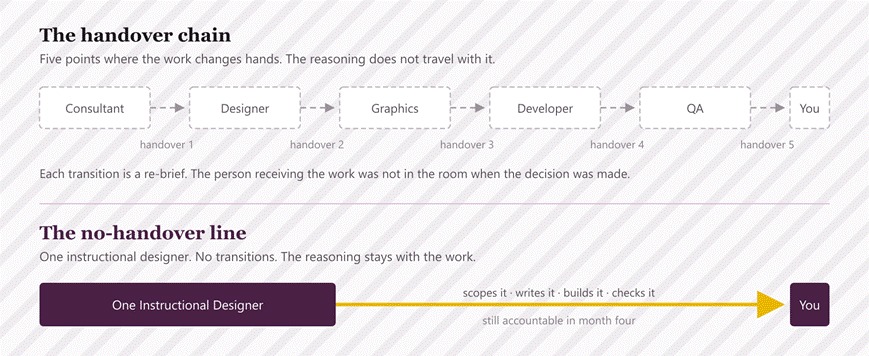
The handover chain versus the no-handover line.
The chain has five points where work changes hands, and the reasoning does not travel with it. The line below has none. That is the entire structural difference between two firms quoting similar numbers.
An Instructional Design House removes that seam rather than managing it: a firm where the designers who scope the work also write, build and check it. Not a claim about effort. A claim about how many times a decision gets re-explained.
Consultant, Build Partner, or Both
Three purchases exist in this market, and buyers routinely make the wrong one. The table separates them by what you actually have on day one.
| If your situation is | What you should buy | What it looks like when you buy wrong |
| You know something is failing but not why, and cannot describe the programme yet | Consulting. A diagnosis and a plan | You commission a build against a guess, then pay to rebuild it after the first pilot |
| You know exactly what to build and to what standard, and only lack hands | A build partner. Design and development capacity | You pay consulting rates to be told what you already knew, and lose a quarter doing it |
| You know the outcome you need but not the curriculum, with a date attached | Both, bought from one accountable party | The strategy arrives, the build is quoted separately, and the plan expires before it is funded |
| Your catalogue keeps growing and the need is permanent, not a project | Ongoing managed design capacity | You re-run procurement three times a year and lose the context each time |
The third row is the common, expensive one: a plan with no funded route to production is a well-researched opinion with a shelf life, not a strategy. The fourth is where certification bodies and licensing schools land, usually after two project cycles, once learning itself becomes the permanent product.
The Budget Squeeze, in Two Numbers
Two figures from the same ATD report frame the conversation right now.
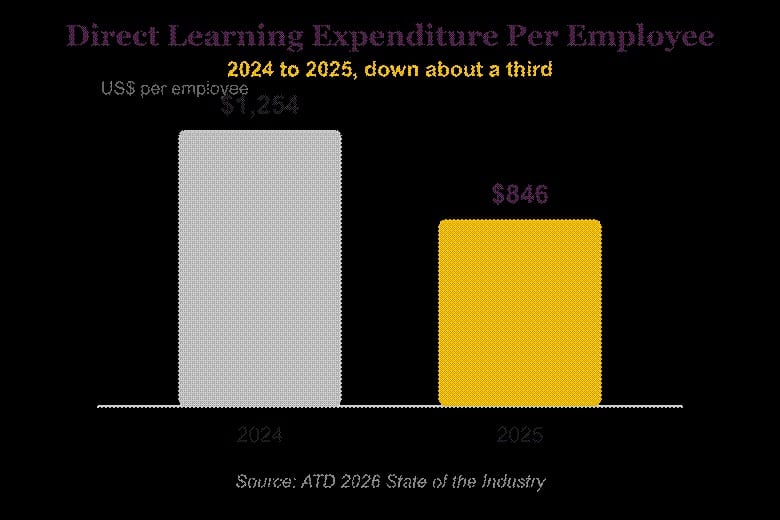
Direct learning expenditure per employee, 2024 to 2025. Source: ATD 2026 State of the Industry.
Direct learning expenditure per employee fell to $846 in 2025, down from $1,254 the year before, a decline of roughly a third.
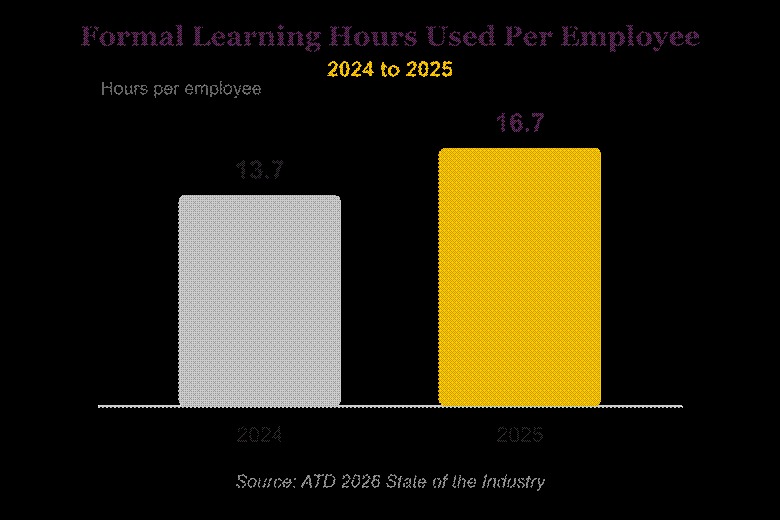
Formal learning hours used per employee, 2024 to 2025. Source: ATD 2026 State of the Industry.
Formal learning hours used per employee moved the other way, rising to 16.7 from 13.7. Teams are being asked to deliver more learning on materially less money, and that arithmetic is what makes an unbuilt strategy expensive rather than merely disappointing.
Count the Handovers: A Calculation for Your Last Project
Here is an exercise no vendor will run for you, using a project you already paid for. It takes about ten minutes and is more revealing than any capability deck.
1. List every party who touched the work, and count them.
2. Count the transitions, not the people. Five parties means four handovers.
3. Find your actual review turnaround, not the contracted figure, typically four to eight working days per round.
4. Multiply handovers by turnaround. Four handovers at five days is twenty working days spent re-briefing.
5. Count the rework caused by lost intent. Feedback that is “technically right but misses the point” is a handover cost, not a quality one.
Steps four and five together are usually the gap between the quoted timeline and the real one.
From the desk
The tell is not delay, it is the flavour of the feedback. Once a review round produces “this is accurate but not what we meant” twice, adding more reviewers makes it worse, because you are adding interpreters, not removing them.
>> Meet the people who would own your engagement before you commit to anything
The No-Handover Check
This is a five-line test you can apply to any firm, including ours. Ask it about a specific piece of delivered work, not a process description. A firm running a conventional handover model will answer with four or five different names, truthfully.
The No-Handover Check
• Who designed it? Name and years of experience.
• Who built it in the authoring tool? Same person, or a different one?
• Who checked it, and against whose written standard?
• What exactly did AI do, and what did it not do?
• Who owned the engagement from first call to final upload?
Run it on our 90-hour real estate licensure rebuild. One senior instructional designer answers the first two lines; Reena Roy, our Head of Design Strategy, answers the third, against standards she owns personally. The fifth line is that same named designer, first call to final upload. On the fourth: AI did research, gap-filling and question-bank drafting. It did not write scripts, and no client content went into a language model.
How to Evaluate a Firm Before You Shortlist It
Most of this decision happens before anyone speaks to a salesperson. 6sense’s 2025 B2B Buyer Experience Report found buyers purchase from one of the four vendors on their day-one shortlist 95% of the time, and a further 83% define their requirements before speaking with sales at all. For a Director of Programs, the useful evaluation work happens before the calls, not during them.
Two of the twelve buyer scorecard criteria matter most here. Instructional judgment: ask for one decision the firm made against the client’s stated preference, and why. On the licensure rebuild, the client expected more video; we recommended audio-first instead, because their learners studied in cars. Measurable outcomes: ask what was measured, who measured it, and what the number was before. A firm that treats measurement as a deliverable has baselines; a firm that treats it as marketing has adjectives.
When You Do Not Need an L&D Consultant
Four situations where hiring one costs you time you do not have. We would rather say this on a first call than three months in.
You already know what to build. If you can describe the programme, audience, standard and deadline, you have done the consulting.
The problem is not a learning problem. Broken process or unclear accountability will not be fixed by a course.
Nobody internally can act on the recommendation. A strategy needs an owner with authority to fund it.
The need is permanent, not a project. Recurring catalogue work at a steady volume is a capacity question, not a strategy one.
Where this doesn’t apply
We are not an LMS vendor and do not administer or configure platforms. We do not run live facilitation, and we do not build native mobile applications. Translation is priced separately. If your problem is platform selection or systems integration, a firm like ours is the wrong spend.
The Decision Underneath the Decision
The question is rarely which L&D consulting firm to hire. It is whether you are buying a diagnosis, a delivery capability, or one accountable party who covers both.
Budgets are tighter than eighteen months ago. A plan you cannot afford to build is now a real cost, not a harmless document. Get the build estimate alongside the strategy, and count the handovers before you sign anything.
You want capacity that does not create more management work than it absorbs, and a named senior designer who owns the work from first call to final upload.
>> Talk to us about what your programme would actually take
FAQs
What does an L&D consultant do?
Diagnoses why a workforce performance problem exists and recommends what learning, if any, will address it. Typical deliverables are a needs analysis, a skills gap map and a measurement plan.
What is a typical L&D budget?
No single figure applies, but the common benchmark is direct learning expenditure per employee: $846 in 2025, down from $1,254 the year before, per ATD.
What is the difference between L&D consulting and instructional design?
Consulting decides what should be built and why. Instructional design decides how it gets built so people actually learn it, and in many firms also builds it.
Do I need a consultant or a build partner?
Buy consulting when you cannot yet describe the programme, audience or standard with confidence. Buy a build partner when you can describe all three and only lack the people.
How long does an L&D consulting engagement take?
A focused diagnostic on one programme typically runs a few weeks. A full portfolio review runs longer, since the constraint is stakeholder availability, not analysis time.
Should the strategy firm also build the courses?
Not always, but know what you give up. Splitting the two adds a handover exactly where design reasoning matters most.


