
eLearning staff augmentation places a contract designer inside your team, and you direct their work day to day. A managed design team is run by the partner, with a named designer accountable for what you agreed. Your team manages outcomes instead of tasks.
For a Head of Learning with a frozen requisition and a growing backlog, the choice depends on who has time to manage extra capacity.
That time is getting scarcer. In ATD’s 2026 State of the Industry report, only 28% of talent development leaders expected financial resources to rise, down from 48% a year earlier.
Budgets are tighter, and the work is not shrinking. So the cost that matters is not only the bill rate. It is the management time each model consumes.
Short answer
Choose staff augmentation when you have a strong internal lead who can brief, review and direct a contractor every week. Choose a managed design team when that lead is the bottleneck and you need finished courses, not extra hands. Teams usually switch when contractor turnover or review load starts costing more than the work itself.
TL;DR
- eLearning staff augmentation adds a contractor you manage; a managed design team adds an owner who delivers.
- It is a decision for Heads of Learning and Directors of Programs facing a backlog with no headcount.
- The hidden cost of augmentation is your own management time, which no rate card shows.
- A year-one in-house hire runs about $129,000 fully loaded and buys one person.
- If project work fills only six of twelve months, that hire costs about $21,600 per productive month.
- Augmentation fails when no one inside has time to direct it.
- Managed teams fail when the scope keeps changing and nobody owns the brief.
>> See how a managed engagement ran on a 90-hour licensure course, from first call to final upload
Table of Contents
1. What Each Model Actually Buys You
2. Why More Hands Rarely Means More Capacity
3. How to Choose in Four Questions
4. The Cost of a Hire, Calculated
5. What a Managed Design Team Looks Like in Practice
6. When Staff Augmentation Is the Better Choice
7. FAQ
What Each Model Actually Buys You
Staff augmentation buys time from a person. A managed design team buys a finished result from a named owner. A permanent hire buys a person and the long-term capacity they build.
The difference shows up in who writes the brief, who reviews the storyboard and who answers when a module slips. With augmentation, all three stay with you. With a managed team, the partner’s named designer holds them, and you approve.
A Director of Programs at a certification body feels this sharply. Their learning is the product, so a contractor who leaves mid-catalogue takes context that nobody else holds. The table sets the three models side by side on the points a buyer can check.
| Point to check | Staff augmentation | Managed design team | Permanent hire |
| Who directs daily work | You | The partner’s named designer | You |
| Who owns delivery dates | You | The partner | You |
| Who writes the brief | You, then the contractor | The designer who builds it | The hire |
| What you pay for | Hours | Agreed outcomes, monthly | Salary, benefits, recruiting |
| Time to start | Days to weeks | Weeks | 6 to 12 weeks, often more |
| What happens when work stops | Contract ends | Retainer ends | Salary continues |
| Main risk | Your review load grows | Scope drift without an owner | Paying for idle months |
Why More Hands Rarely Means More Capacity
The assumption is that adding a designer adds capacity. The reality is that it adds capacity only if someone has time to direct them.
A contractor arrives without your context. Someone must brief them, review every storyboard and correct the first drafts. For an L&D Manager already running five projects, that someone is the same person who was overloaded before.
Augmentation also spreads the work across more hands. The contractor drafts, an internal reviewer edits, a developer builds and a coordinator chases sign-off. Each handover is a re-brief, and each re-brief is where intent gets lost.
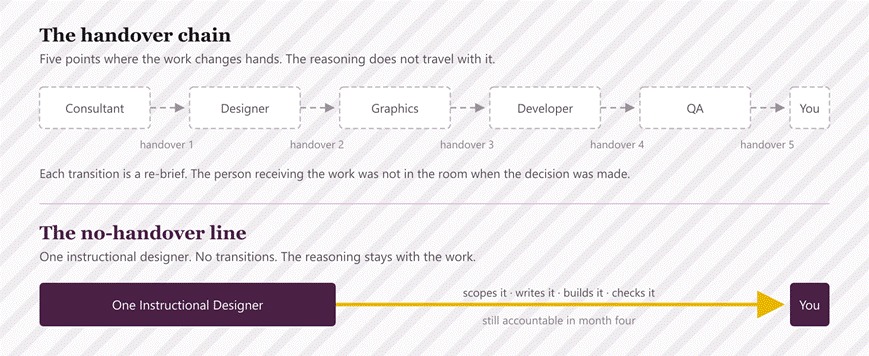
The handover chain versus the no-handover line. Reused verbatim from earlier posts. Alt text: Four-step handover chain from instructional designer to graphics to developer to QA to you, shown greyed and dashed, above a single unbroken gold line from instructional designer straight to you.
The greyed chain above shows the usual path: designer to graphics to developer to QA, then finally to you. The gold line below it shows the alternative, where the designer who scoped the work also builds and checks it. Fewer handovers means fewer re-briefs for your team to absorb.
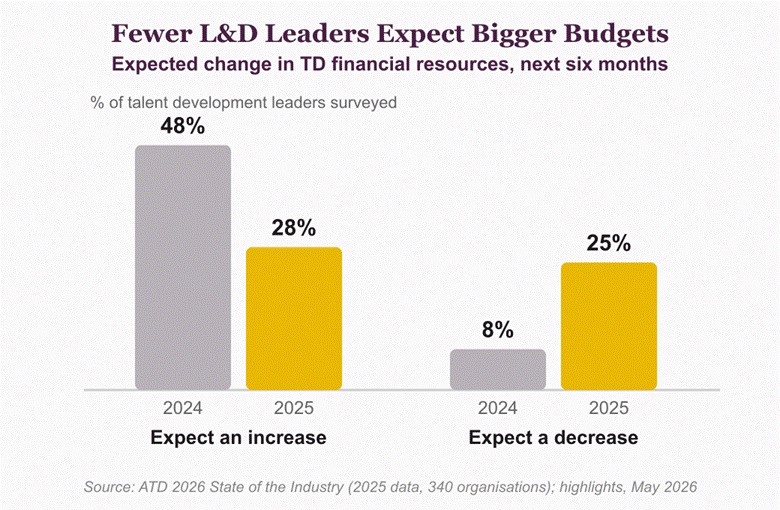
Talent development leaders expecting financial resources to rise or fall in the next six months: 48% increase and 8% decrease in 2024; 28% increase and 25% decrease in 2025. ATD 2026 State of the Industry. Alt text: Grouped bar chart, grey 2024 bars beside gold 2025 bars, showing fewer leaders expect increases and more expect decreases.
The chart compares two years of ATD survey data on budget expectations. In 2024, 48% of talent development leaders expected resources to increase and 8% expected a decrease. In 2025, those figures were 28% and 25%.
A leader planning capacity today should assume flat or falling budgets.
Source: [ATD, Highlights From ATD’s 2026 State of the Industry Report](https://www.td.org/content/atd-blog/highlights-from-atd-s-2026-state-of-the-industry-report)
How to Choose in Four Questions
Four questions decide the model, and a Head of Learning can answer all four in one meeting. Answer them with the person who would manage the extra capacity in the room, not only with procurement.
- Do you have an internal lead with at least a day a week to direct a contractor? If not, augmentation will stall.
- Is the scope stable for the next three months? If not, a managed team needs a tighter brief first.
- Is the work a project with an end date, or a steady flow? A steady flow favours a retainer or a hire.
- Does the learning sit at the heart of your product, as it does for a licensing school? If yes, continuity matters more than rate.
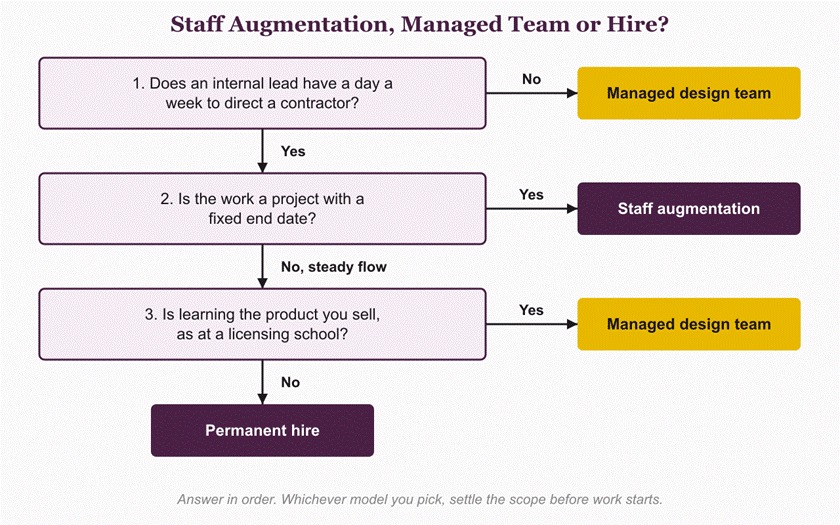
Decision tree: staff augmentation, a managed design team or a permanent hire. Alt text: Three yes-or-no questions in order leading to managed design team, staff augmentation, managed design team or permanent hire.
The decision tree puts three of those questions in order. No internal lead with time points to a managed team, and a lead with a fixed-end project points to staff augmentation.
For a steady flow of work, learning that is your product points to a managed team. Anything else points to a permanent hire.
Scalability is the buyer-scorecard question this section answers. The model that scales is the one whose management load does not grow with every designer you add.
The Cost of a Hire, Calculated
A permanent instructional designer costs about $129,000 in year one, before they finish a single course. Glassdoor’s 2026 US data puts average salary at $92,450.
Add benefits and payroll taxes at an assumed 25% and recruiting at 15%, the low end of the common range. That is $92,450 × 1.40, or about $129,400.
Now the calculation most budgets miss. If project work keeps that designer fully busy for only six months of the year, each productive month costs about $21,600. At twelve busy months, it costs about $10,800.
| Months of real project work | Year-one cost | Cost per productive month |
| 12 | ~$129,400 | ~$10,800 |
| 9 | ~$129,400 | ~$14,400 |
| 6 | ~$129,400 | ~$21,600 |
Robert Half’s 2026 data puts the midpoint salary at $96,500, so the real figure may be higher. For a Director of Programs whose course work comes in waves, the idle months are the real cost of a hire.
About $21,600 per productive month
That is what a year-one hire costs if real project work fills only six months. It is the number to compare against any augmentation rate or managed retainer.
Source: [Glassdoor, Instructional Designer Salary, US 2026](https://www.glassdoor.com/Salaries/instructional-designer-salary-SRCH_KO0,22.htm), with stated assumptions
What a Managed Design Team Looks Like in Practice
A managed team works when one named designer owns your work from the first call to the final upload. That designer scopes it, writes it, builds it and checks it, so nothing is lost between stages.
VonGeyer Consulting runs this way. It is an Instructional Design House, meaning a firm where the instructional designers who scope the work also write it, build it and check it. Quality is checked against design standards owned personally by Reena Roy, Head of Design Strategy.
The clearest example is scale. For a US real estate school, VonGeyer rebuilt a 90-hour licensure course audio-first in five months. It was delivered in monthly work packages with throughput reporting, straight into the client’s own LCMS.
A Director of Programs judging any managed offer should ask for the same three things. A named owner, a monthly delivery report, and a minimum term short enough to test the fit.
>> Meet the people who would own your work before you commit to a retainer
When Staff Augmentation Is the Better Choice
Staff augmentation is the better choice when you already have the leadership and only lack hands. A Head of Learning with a strong senior designer and a short, well-defined project should simply add a contractor.
It also wins when the work must sit inside your systems all day. Examples include daily stand-ups, internal tools only your staff can access, or security rules that bar outside teams.
A managed team is the wrong choice when the brief changes weekly and no one inside owns it. No partner can deliver to a moving target, however good the designers are.
Where this doesn’t apply
VonGeyer does not place contractors inside client teams, and it is not a staffing marketplace. It is also not the right fit for a 10,000-seat rollout that needs five specialists in parallel this month. Live facilitation and native mobile apps are outside scope, and translation is priced separately.
If your need is two extra pairs of hands for eight weeks under your own lead, a staffing firm is the honest answer. If your need is someone to own the outcome, read on to the FAQ.
What Changes When Capacity Stops Creating Work
The choice is not about the hourly rate. It is between help you manage and help that manages itself. For a stretched L&D team, the right model adds finished courses without adding a second job for the person who was already overloaded.
>> Talk to Julian about which model fits your backlog and your team
FAQ
What do you mean by staff augmentation?
Staff augmentation means adding external people to your team for a set period while you direct their work. In eLearning, it usually means a contract instructional designer or developer who works to your briefs, in your tools, under your management.
Is staff augmentation considered outsourcing?
It is a form of outsourcing, but a narrow one. You outsource the hiring and employment of the person, not the responsibility for the result. With a managed team or a project partner, responsibility for delivery moves to the partner too.
What are the advantages and disadvantages of staff augmentation?
The advantages are speed to start, flexible length and full control over the work. The disadvantages are the management time it takes, the context lost when a contractor leaves and the review load that stays with your team.
What are the key differences between consulting and staff augmentation?
A consultant advises on what to do and usually hands the plan back. Staff augmentation adds people who do the work under your direction. A managed design team does the work and owns the result, which is a third model between the two.
What are the best practices for staff augmentation?
Name one internal lead who has time to direct the contractor every week. Write a clear brief and a fixed review process before day one. Keep source files in your own systems so nothing leaves with the contractor.
